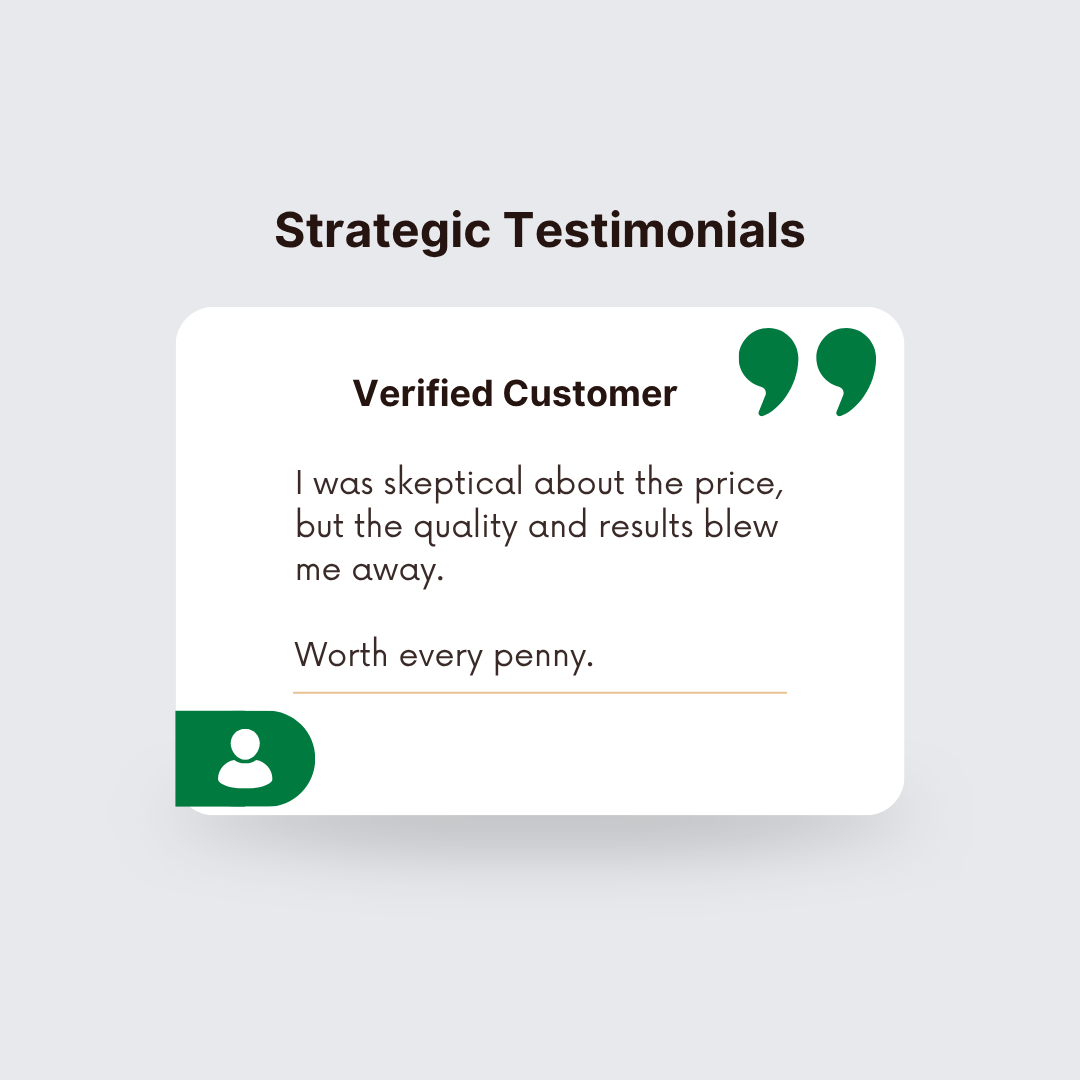
“Use social proof in your emails.”
It’s one of the most repeated pieces of advice in email marketing.
It’s good advice — customers are naturally skeptical of brand language and will trust other customers’ words more.
But too many times, brands interpret “use social proof” as “reach into the testimonial grab bag and pick some random testimonials.”
And so most testimonials end up being clutter.
They lengthen the copy without adding value, diluting your message and losing readers.
So let’s talk about how to use testimonials the right way, the way I do it. But first…
| Table of Contents |
| Why Testimonials Fall Flat The Right Way to Use Testimonials Putting It Into Practice Stop Throwing Testimonials at the Wall What To Do Next |
Why Testimonials Fall Flat
Testimonials often fall flat for a few reasons:
- Too short: They don’t convey anything valuable. “Great product!” and “Love this brand!” don’t help the customer make a decision. It may as well be you saying those. It also smacks of laziness.
- Too broad: They don’t cover specific issues or objections the reader needs to hear. A glowing paragraph doesn’t matter if it doesn’t connect with something the reader is hung up on.
- Randomly chosen: They’re nothing but clutter. There’s no thought into why the testimonial is there. It might not even be relevant to the product.
In all cases, “positive” does not mean “useful.”
The Right Way to Use Testimonials
For a testimonial to be useful, it must be contextual and relevant.
Before I pick a testimonial, I look at three things:
The product
A testimonial that speaks glowingly of one product means little when promoting another. Match the testimonial to what you’re actually selling in that email.
This may entail some technical wrangling for certain flows that require product-based personalization, like Abandoned Carts, if you want product-specific testimonials.
The buyer’s stage
Someone in a Welcome Sequence is in a completely different headspace than someone who just abandoned at checkout.
The objections, hesitations, and desires at each stage are different…
And the testimonial you choose should speak to whichever ones are most relevant at that stage.
The segment
Similar to the last factor, a brand-new subscriber needs to hear something different than a lapsed customer or a longtime VIP.
Who you’re talking to shapes what they need to see.
Knowing these three things helps me choose testimonials that actually connect with customers and increase the chance they buy.
Putting It Into Practice
Welcome Sequence
A new subscriber who got on your list via the opt-in doesn’t know you yet.
They’re interested, yes — otherwise they wouldn’t be on your list — but you’re still building trust with them.
Testimonials here should NOT focus on specific products, unless you do a “product recommendation” email and want to attach a testimonial to each, or you have a clear hero/front-end offer to promote in its own email.
Welcome Sequence testimonials should focus on:
- Overall product quality
- The customer experience/service
- Company values
- The transformation they’ll experience (future-pacing)
Reviews should ultimately answer the unspoken question every new subscriber has:
“Is this brand actually worth my time and money?“
Browse Abandonment Flow
At browse abandonment, someone viewed a product but didn’t add to cart. That’s some interest, but not enough to “commit” in any real sense.
The hesitation here is usually about relevance, with customers wondering, “Is this actually for someone like me?” or “Will it work for my specific situation?”
Price can also be an objection here. But not for the reason you think.
Browse Abandonment testimonials should focus on:
- Identity (“Is this for me?”)
- Transformation (“Will this work?”)
- Product features + benefits
- Product quality
- Value for money, especially for higher-priced items
Testimonials should focus specifically on the product viewed, obviously.
The goal is to help the reader see themselves in someone else’s experience and think, “if it worked for them, it might work for me.”
Abandoned Cart
Someone who added a product to their cart wanted it, but something stopped them before they got to checkout.
Hesitations tend to be practical here.
Price is common since they saw the total and paused. But it is a bit different since they:
- Actually added it to cart after seeing the price tag
- Haven’t reached checkout to see price + taxes + shipping costs in a neat format
So price itself isn’t as big a deal in absolute terms. It’s relative. Meaning they’re comparison shopping.
Thus, a key difference from Browse Abandonment is that you want to find reviews that demonstrate superiority to other brands.
No need to mention those other brands, but things like “I tried so many other places, but only Brand X was able to deliver.”
Abandoned Cart testimonials should focus on:
- Value for money: Customers who felt the price was worth it
- Product quality: Reinforcing that what’s in their cart delivers
- Comparisons: Saying that your brand beats others
- Results: Reminding them why they added it in the first place
Abandoned Checkout Flow
Someone at checkout is closer to buying than anyone else in the funnel. One page stands between them and the sale.
And what’s on the page?
Information about pricing, shipping, and taxes, as well as the payment information boxes.
So the hesitation may still be somewhat about the product, but less so, because they added that product to cart and kept moving.
Instead, it’s about all those logistical things I just listed — pricing, shipping, taxes, and payment security.
Abandoned checkout testimonials should focus on:
- Customer service experiences (Responsive, helpful, and non-defensive)
- Easy returns/hassle-free policies
- Fast shipping/delivery, if applicable
- Payment security
- Value for money
- Overall product/brand reliability
Post-Purchase Flow
You received the revenue, but the sale is not done. Even after someone pulls the trigger, there’s often a small voice wondering if they made the right call by taking your offer.
The Post-Purchase Flow must silence that voice by reinforcing the customer’s decision rather than hammering objections as you did earlier in the funnel.
Testimonials here reassure them that the product delivers and that other customers are glad they bought…
But more importantly, build excitement for what’s coming.
Transformation-focused stories that help the new buyer visualize their own outcome and look forward to experiencing it themselves.
One other thing:
Upsells in your Post-Purchase Flow should leverage testimonials that show how the upsold product complements the main product or solves a specific problem existing buyers have.
Not mandatory, but personalization boosts sales.
Post-Purchase testimonials should focus on:
- Reassurance: Stories that confirm they made the right call
- Transformation/results: Show what they could experience once the product/offer arrives and they start using it
- Customer service: Particularly for post-purchase issues that customers encounter
Done right, these testimonials can help you keep those customers around in the long term.
NOTE: Consider asking “Why did you buy?” in the first hype-building email right after they bought.
This is a good spot to potentially gather information about soft objections people may have and what helped them overcome them…
Informing your testimonial selection in other front-end flows.
Winback Flow
A lapsed customer is not a lost customer yet. They bought from you once, so they trusted you enough to spend money before.
And so they aren’t hesitating for the same reasons as a new lead.
Their skepticism is more about whether you’re still relevant or if you can deliver better results than before.
Winback testimonials should focus on:
- Long-term/consistent results: Customers who used the product regularly and kept seeing value or saw increased value
- Changes or improvements: This speaks to customers who left due to something you have since fixed or built on
- What they’ve missed: These rekindle the original appeal of the brand
Push to Continuity Flow
A customer in the Push to Continuity Flow has purchased the same product multiple times.
A subscription is a logical upsell, but the ask is big — a recurring commitment.
So the customers will primarily be concerned about locking into recurring billing.
What if their situation changes?
What if they need to pause or change their order?
Will they actually see better results by sticking with this long-term?
Are there any other benefits to subscribing?
Push to Continuity testimonials should focus on:
- Consistency of results: Customers who saw better outcomes from regular, uninterrupted use
- Subscription management: How easy it is to pause, cancel, and adjust
- Customer service: How helpful and responsive customer service is about solving any issues, but particularly subscription issues (pausing, adjusting, canceling, answering questions)
- Convenience: How much easier life is with regular, unthinking delivery (or how much harder it got when they ran out of their product)
NOTE: Two of the other subscription flows — the Subscription Upgrade and Subscription Expansion Flows — can also use testimonials.
The Upgrade flow would highlight the benefits of having more/larger sizes of the customer’s product, while the Expansion flow would highlight complementarity or simply feature plain-old testimonials for the cross-sold product.
Stop Throwing Testimonials at the Wall
Testimonials are not random things you throw at the wall, but strategic assets to be deployed in the right circumstances…
And the reader’s headspace and objections, as well as the product, all play a role.
A customer in a Welcome Sequence needs different proof than one who abandoned at checkout. A lapsed customer needs different proof in a Winback Sequence than a customer who just placed an order.
I like to trawl my client’s testimonial database and pull out the best ones for different products, ensuring I cover a variety of objections.
Big time-saver.
If you want to improve the quality of your testimonials (or improve the quantity of high-quality ones), structure your Review Request Flow correctly.
Give them some prompting questions to answer and encourage them to provide more information.
That way, you’ll have far more in-depth proof pieces to use everywhere.
One last thing…
Registration for my new workshop, Angles On Demand is now live. You’ll learn how to generate hundreds of email angles in grid format in as little as 5 minutes using AI.
What To Do Next
- Share this article with someone who might find it helpful (or entertaining).
- Subscribe to my Substack to get these in your inbox every Friday.
- Get my free eBook using the form below to learn the 5 things stopping you from turning “one-and-done” customers into repeat buyers.
- Grab my 21 best email templates/frameworks.
- Reach out to me at info(at)bradleyschnitzer.com if you have a sizable email list and make less than 20% of your revenue through email.