A couple years back, I started working with a large mealbox delivery brand.
Early in our onboarding, while we were poking around their Klaviyo on a call, the director of sales started venting about their poor experience with the previous agency.
“Here, check out the Cart Abandon to see what I mean,” he told me.
So I opened it, and yeah, I see why.
It was 2 emails. 2 giant, heavily-designed, billboard-ad-ass emails with 18 sections that have nothing to do with each other or the subject line.
Not to mention obvious flows were missing entirely. Things like a Post-Purchase Flow, for example.
Meanwhile, I saw next to NOTHING in the way of broadcasts. The last agency seems to have done no more than a weekly email (often closer to bi-weekly) in the same terrible billboard style.
Of course, not every agency is like this.
I’ve worked with several that do excellent work for their clients (partly because I’m doing the copy + strategy).
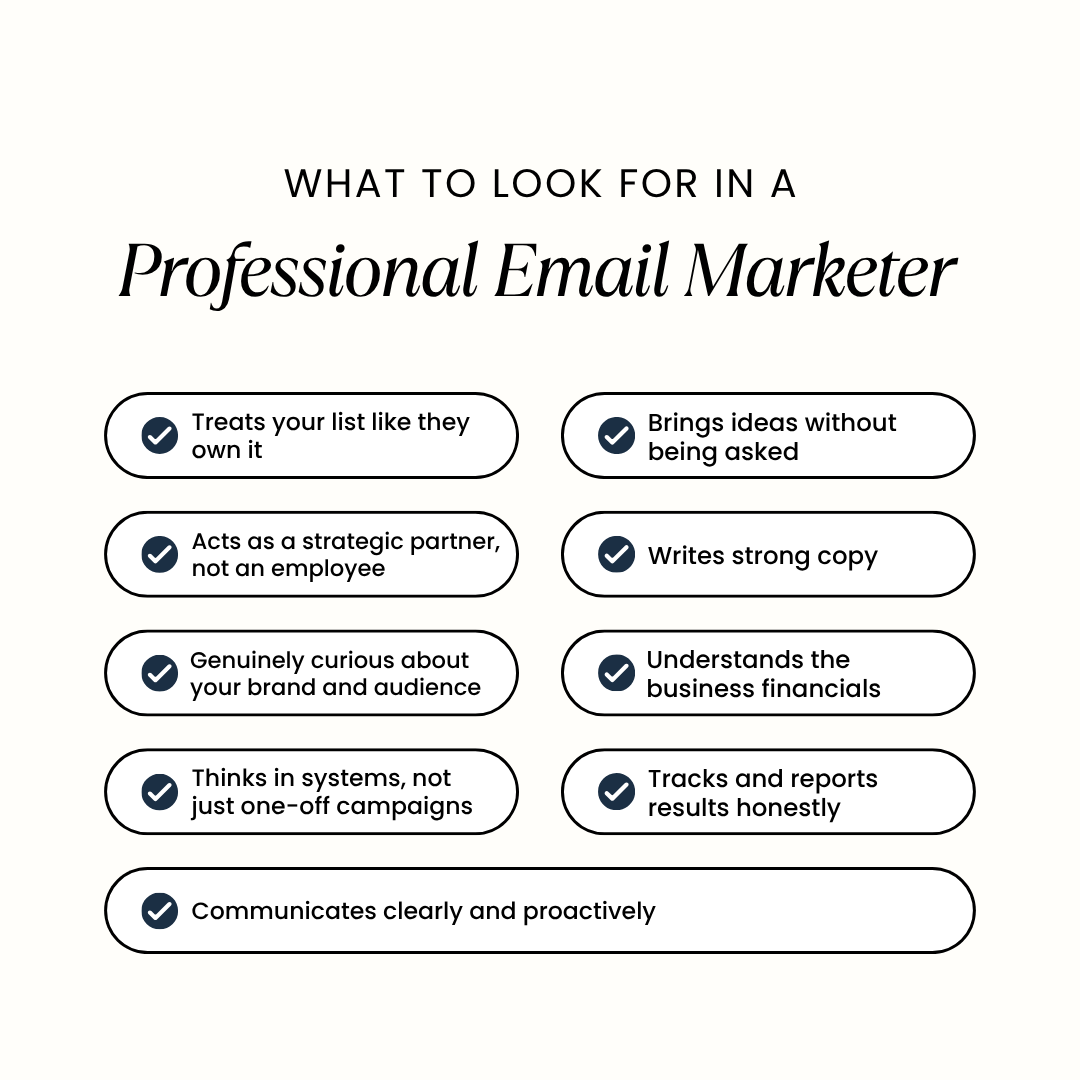
So I put together this list of what to look for in a professional email marketer. Keep these in mind when looking around for someone you can trust to manage your list well.
1. They Treat Your List Like They Own It
An email marketer doesn’t have the same incentive to care for your list as you do. They don’t own it. The worst that happens is you yell at them, and they lose your retainer fee.
Classic principle/agent problem.
So one of the most critical things to look for is an email marketer who treats your list (and your business) as if it were theirs.
That means they won’t chase short-term volume at the expense of list health. Nor will they run constant discount promos to generate tons of revenue at your bottom line’s expense. Nor will they recklessly pursue any other goal regardless of the impacts on other parts of your business.
Instead, they’ll take care to protect your list health, grow + maintain subscriber relationships, and take a more comprehensive approach — even if their work looks less impressive at first.
The simplest test: would they make the same decision with their own list? If the answer is yes, you’re in good hands.
If they’re recommending things they’d never do to their own audience, that’s worth paying attention to.
2. They Act Like a Strategic Partner Instead of an Employee
Contractors (like self-employed email marketers or agencies) aren’t employees. They work with you, not for you. And that’s a good thing.
A good email marketer will bring a point of view and an understanding of where email/SMS fits within the broader business — how it connects to acquisition, retention, revenue, and customer lifetime value — and use that understanding to inform recommendations.
That means they won’t act as a mindless drone. They’ll push back when something doesn’t make sense to them.
For instance, if you wanted to blast your entire list with a discount the week after a sale ended, a good email marketer will warn you against that.
Or if you want to chop up your segments into tons of micro-segments, they’ll caution that the time spent doesn’t yield a return in terms of revenue.
Ultimately, it’s your business and your list. So you can ignore them and have them do it anyway. But they will advocate for what they believe (based on prior experience) will move you forward.
Don’t be surprised if they eventually part ways with you, though.
This goes the other way, too. They don’t seek permission for every small decision. They get buy-in for big things, like strategy changes or major campaigns, and handle the rest themselves.
3. They’re Curious
The more information I have about you, your product, your brand, and your target audience, the easier it is to plan strategy AND write copy.
Without this stuff, I flounder. I lack the raw materials to build the strategy and copy.
Thus, a clear sign you’re speaking with the right person is that they ask you LOTS of questions about them.
Typically, they’ll do a big kickoff call, part of which entails asking these questions.
Curiosity shouldn’t stop at onboarding. Great email marketers ask you for things like:
- Testimonial/review database
- Past copy examples
- Existing calendar, if any
- Other assets (landing pages, lead magnets, etc.)
- Any extra information on offers
And more.
Then, they’ll go off and do their own research. They’ll scour your site, competitor sites, and online forums. They’ll learn the terminology and language the niche speaks.
Good email marketers are curious about their own craft, too.
They stay up to date on changes in marketing, copywriting, email, and everyone’s favorite, AI.
An email marketer who is always learning, asking, and looking for better angles gets better over time through general skill development, niche knowledge acquisition, AND by familiarization with your business.
Far better than someone who shows up with nothing but their fixed “best practices” playbook.
4. They Think in Systems, Not Just Campaigns
Any old copywriter can “write daily emails” if they have enough email ideas.
A systems thinker sees how everything interacts — campaigns, flows, different offers, the customer lifecycle, etc.
Simple example:
Anyone in an email sequence generally should not receive broadcasts. A good email marketer builds a “flow exclusions” segment to keep those people out of broadcast sends.
Another example:
An amateur ends the Abandoned Cart Flow after 2-3 half-decent reminder emails.
A professional considers what might be stopping the customer from reclaiming their cart, then adds emails to address each objection.
On more:
A systems thinker considers what a Product A customer would buy next and personalizes the Post-Purchase Flow to cross-sell it to them, rather than adding a generic upsell or none at all.
Regardless…
This type of person spends more time auditing your Klaviyo but finds everything missing. Missing sequences, flows that stop short of their potential, emails that don’t urge action, etc.
And, on top of that, can “zoom out” when it comes to planning your email calendar every month/quarter.
5. They Communicate Clearly and Often
You shouldn’t have to chase your email marketer for updates.
A good one keeps you informed without you asking. They’ll tell you what they did, what they’re working on, what’s coming next, and what they need from you regularly.
It goes the other way, too.
When something underperforms or something goes wrong, they tell you. They don’t move on and hope you don’t notice the numbers.
They come to you with what happened, why they think it happened, and what they’re going to do about it.
After all, they understand a single flopped campaign is NOT a skill issue. Other things could be the cause, and getting both of your brains on it could uncover it.
It should feel like the retainer is mostly “running itself.” You participate insofar as the marketer needs things they can’t provide themselves (like client approval or specific pieces of info/research on the brand).
6. They Proactively Bring Ideas
Good email marketers don’t wait for you to hand them briefs or ideas.
Instead, they’re always on the hunt for ideas themselves.
Maybe they identify a strong email angle in something you said, or perhaps they found a solid offer idea by looking at another brand in your niche, or something else.
One example from my work was finding ways to gain more Subscribe & Save customers and to make each more lucrative.
Discussions with the client + my own thinking led me to create the email sequences that make up my Subscription Ascension System, like the Subscription Upgrade Flow.
None of this is to say that you must only use their ideas. If you have ideas for email angles, promotions, offers, and so on, bring them to your email marketer.
They’re happy to give their input on whether something’s a good idea and, if so, the best way to go about it.
Even then, though, they’re giving you their ideas on your ideas. So the principle still applies.
Overall, the best email marketers make you feel like they’re always thinking about your list and ways to get more out of it.
7. They Can Write Good Copy
Setting up flows in Klaviyo and writing emails that sell are two different skills.
I know Klaviyo-savvy techie people who aren’t copywriters. Nothing wrong with that. Their thing is being a tech wizard, not a persuasion maestro. They build the flows, create discount codes, and solve other tech problems for us.
But the email marketer themself — for whom basic technical competence does matter (scheduling emails, building sequences, creating segments) — must be a solid copywriter.
That means knowing:
- How to write solid subject lines and preview text
- How to hook the reader from the first line
- How to shift beliefs and educate them toward the purchase
- How to tell stories and entertain
- How to leverage proof to back up claims and appeal to “on-the-fence” customers
- How to build toward a CTA that feels like a natural next step
And you can’t nail these without a deep understanding of:
- Offer
- Audience
- Promo/campaign theme (if any)
- Individual email angle
Hence, why I emphasized repeatedly that good email marketers will communicate often and ask lots of questions.
Copy flows from strategy.
You can hire simply for strategy, but the email marketer will be more of a consultant. It’ll be on you to take their ideas and translate them into copy.
Or, you can hire for both (which will be a larger investment) and let the expert handle it all.
8. They “Get” The Financials
Opens, clicks, revenue/send… things like this tell you how the email channel is performing. Important, yes, but you run a whole business, not just an email list.
A strong email marketer understands the financial numbers. They know about things like Cost Of Goods Sold (COGS), fixed costs, inventory, etc.
For instance, have they heard of a “loss leader?” This is a front-end product you intentionally lose money on to maximize front-end conversions, aiming to recoup the losses with a profitable back-end.
Or, say you’re considering a 20% off sitewide discount campaign.
An email marketer without the business knowledge would see dollar signs. They’d tell you to run with it.
But do they know your profit margin? Do they understand your COGS?
A 20% discount might mean more sales, but 20% fewer $$$ per sale could leave you worse off.
A smart email marketer would localize the discount to a specific category (with plans to recoup “losses” on the back end) or suggest alternative offer ideas that preserve margins.
Or how about when one of my clients had a product that wasn’t moving. Their other product sold well, and they needed warehouse room for a highly anticipated new item.
We offered a steep discount to liquidate cold inventory and make room for the hotter items.
A mid-tier email marketer may worry about “losing money.”
But the smart email marketer knows you’d rather sell a $100 product for $50 than have a $100 product they can’t sell (and thus have $0 cash). We “cut our losses,” knowing we’d recoup them by selling popular and new items.
The broader the numbers they understand, the better the decisions they’ll push you toward. Not just “how do we get more revenue from email this month?” but “how do we use email to move the metrics that actually determine whether this business is growing healthily?”
9. They Track and Report Results (Properly)
A good email marketer tracks performance consistently and presents it to you in a way that’s clear and actionable:
- Here’s what happened
- Here’s why we think it happened
- Here’s what we’re doing about it
You should be able to read their report and know immediately whether things are moving in the right direction.
I like to do shorter, “at a glance” reporting weekly, with perhaps a monthly check-in call. Weekly reporting may also include a Loom of me explaining the report.
Keeping things mostly asynchronous saves both parties time on the call itself AND on coordinating the call. Lets the client check the reports whenever they have time.
A great email marketer also owns the results.
When something underperforms, they don’t point fingers or make excuses. They come with an explanation and a plan. That accountability is part of what makes the relationship worth having.
They’re honest about attribution, too. Email platforms let you adjust the “attribution window” — the specific time frame after a customer opens the email during which their order is credited to the email.
If the window’s set to 30 days, someone could open an email, wait 29 days, and buy… and the email will be credited. Yet common sense says the email played, at most, a minimal role.
Good email marketers point this out and don’t hide behind inflated or inaccurate attribution windows. They may suggest checking against overall revenue changes or per-product sales data, including with external tools if the ESP’s reporting seems off.
Hire Well, Mail Well, And Make the Most Of Your Investment
Hiring the right email marketer pays for itself many times over — both in revenue generated and costly mistakes avoided.
Look for someone who treats your list like an asset worth protecting, thinks beyond the next send, brings ideas without being asked, and can back it all up with copy that actually sells.
Just as critical is that your chosen marketer understands your business numbers, communicates proactively, and is honest about what’s working and what isn’t.
That person exists, but they’re not easy to find…
You’re in luck, though. You found one.
So if you’re looking for an email marketer who checks these boxes (or want a second opinion on your current email program) hit reply and let’s talk.
What To Do Next
- Share this article with someone who might find it helpful (or entertaining).
- Subscribe to my Substack to get these in your inbox every Friday.
- Learn 10 key email automations that unlock 10-15% more store revenue without extra ad spend.
- Grab my 21 best email templates/frameworks.
- Reach out to me at info(at)bradleyschnitzer.com if you have a sizable email list and make less than 20% of your revenue through email.