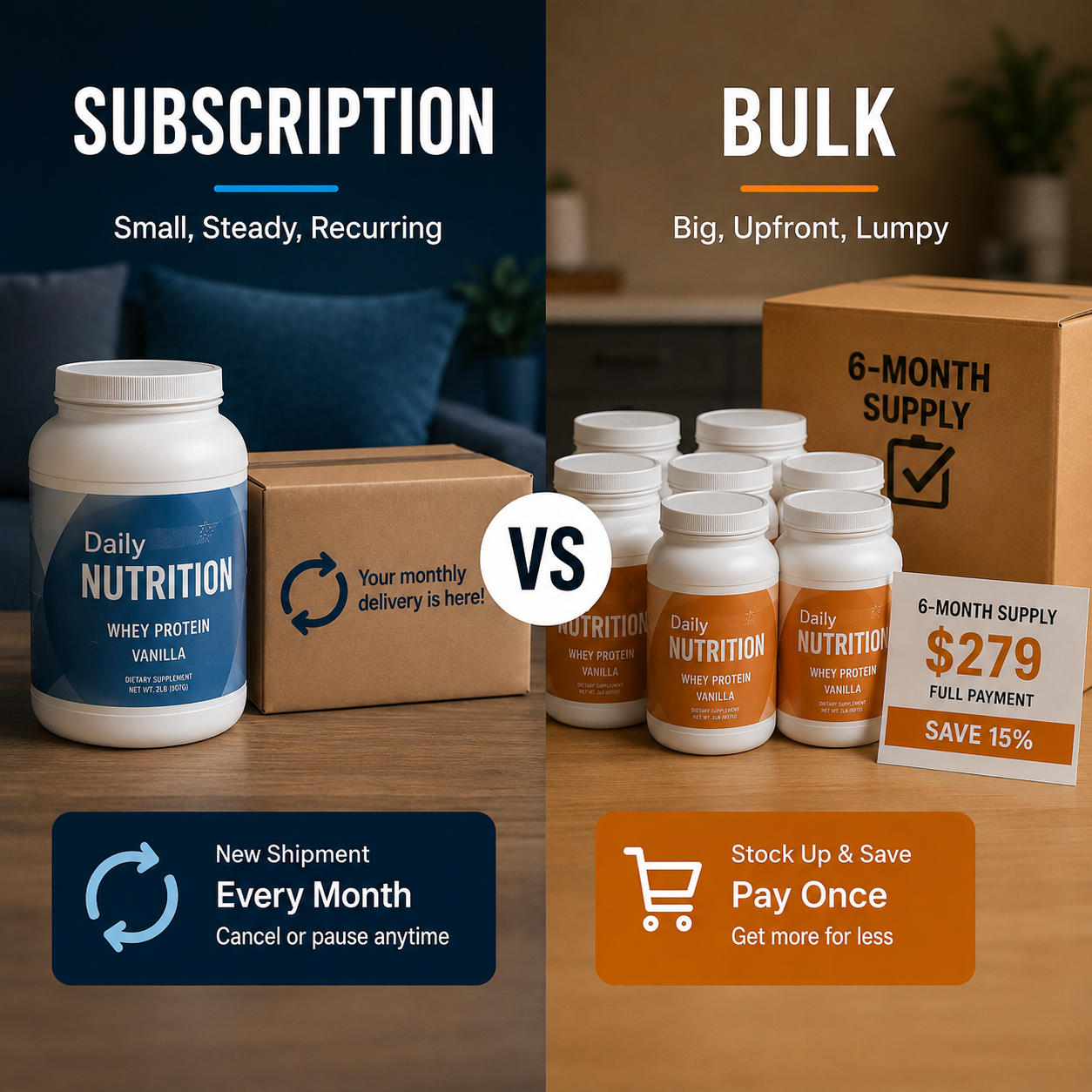
One of our clients has a product that almost every customer who tries it falls in love with.
We see high repurchase rates and solid reviews, with few complaints. They quickly integrate it into their routine, making it a daily necessity…
And so tons of our first-time customers hop on a subscription, which serves as our back-end offer.
But this made us reevaluate:
Is a subscription program really the best offer? If people are so hyped to repurchase… Why not scrap the subscription program for bulk orders?
That way, the customer gets a 3, 4, or even 6-month supply upfront while the brand gets a huge cash surge they can reinvest in acquisition, hiring, and so on.
We haven’t made that move yet. But the idea made me want to explore each model’s benefits and tradeoffs.
Below, you’ll see these for each so that by the end, you have a clearer sense of the best offer type for your business.
| Table of Contents |
| Subscription/Continuity Offers Bulk Orders The Verdict: Subscription, Bulk, or Both? What To Do Next |
Subscription/Continuity Offers
A continuity offer — often called a subscription offer — charges the customer a recurring fee in exchange for ongoing delivery of a product or access to a service.
The customer continues paying monthly (or whatever interval you use) until they cancel or pause.
For physical products, this typically looks like recurring delivery on a set schedule. For example, getting a supplement every month, a meal kit each week, or a skincare product replenished every six weeks.
The customer gets convenience and often a small discount in exchange for their commitment.
The brand gets predictable, recurring revenue.
Pro: Predictable Recurring Revenue
The most obvious benefit of subscription offers is that revenue comes in every month.
That feels good, but the practical advantage is that it gives you a “floor” from which to work.
Such predictability makes planning easier (inventory, staffing, marketing spend, etc.) and reduces the feast-or-famine cycle that plagues brands relying entirely on one-off purchases.
Pro: Easier To Sell Up Front
Subscriptions don’t entail dropping huge money up front. In fact, many brands offer a discount in exchange for the subscription, such as 5-10% off every order.
Much easier to say “yes” to, say, one $30 tub of protein/month than $300 for 10 tubs.
Important for new customers. Bulk and subscription are both harder to sell to them on the front end due to the commitment, but subscription isn’t as tough.
Pro: Builds a Deeper Ongoing Relationship
A subscriber is a customer you stay in regular contact with.
Every renewal, shipment, and email is another opportunity to deliver value, reinforce the brand, and deepen loyalty.
For example, you might send them a few emails at each renewal notifying them of their upcoming order, reinforcing their choice with testimonials, and asking if they need help or want to add anything.
Speaking of that… that means more selling opportunities.
For instance, you encourage customers who have been subscribed for several months to upgrade to a larger size by framing it as a way to get more of what they love.
Or you might try to sell them on a complementary product (one-off or subscription).
Over time, subscribers can become your most engaged and most valuable customers precisely because the relationship compounds.
Con: Less Cash Flow Up Front
The flip side of spreading payments out over a long period is that you spread cash flows thin.
You might have 1,000 active subscribers pulling in steady revenue, but you won’t see huge cash surges unless you add plenty of new customers at scale.
Brands needing capital to grow may not find this as ideal as bulk orders.
Con: More Operational Complexity
Subscriptions require infrastructure:
- Renewal management
- Cancellation handling
- Pause options
- Dunning sequences for failed payments
- Customer service around billing issues
None of this exists with a one-time purchase.
The more subscribers you have, the more moving parts you manage on an ongoing basis.
Con: Requires Ongoing Retention Efforts
The “sale” is never truly done.
A subscriber can cancel anytime, so you must continuously earn the renewal.
That requires consistent communication, ongoing value delivery, and active retention efforts.
If you go quiet or the product stops feeling worth it, churn follows.
To illustrate:
A $50/month subscription takes 10 months to earn $500. You’d need almost a year to get the equivalent of 1 instantaneous $500 bulk order (although “instantaneous” may involve a longer sales cycle).
Bulk Orders
A bulk order lets the customer purchase a larger quantity upfront, typically at a discount.
For example, a brand may offer a two-month supply for 5% off. Some brands also do multiple tiers, where you can buy a larger amount for the same (or a larger) discount.
The customer pays more in a single transaction but pays less per unit overall.
The brand receives a larger sum of cash immediately rather than collecting it in smaller installments over time.
Pro: Huge Cash Flow Surge Up Front
A bulk order puts lots of cash in your pocket immediately, vs. a subscription that spreads payments out over weeks or months.
For example:
A $300 bulk order of skincare products that lasts 10 months puts $300 into your pocket immediately. A subscription, on the other hand, could take 10 months. Not to mention the risk of pausing or canceling.
By collecting more cash up front, you have more money to pay your bills and reinvest into projects/initiatives that’ll grow you more (*ahem* ads or email, perhaps).
Pro: Operationally Simple
A bulk order is a single payment. Once a customer places an order and you ship it, the operational work is basically done.
There are no renewals, auto-billing payment failures, cancellations, etc. Customer service may still be needed given order size, but they won’t get bogged down in help requests regarding subscriptions.
It’s clearer for the customer, too. They get what they see. Fewer things for them to get confused over.
Pro: You Can Set Up “Tiers”
Bulk orders lend themselves naturally to tiered pricing structures. One example:
- 1-month supply: Full price
- 3-month supply: Moderate discount
- 6-month supply: The best discount
Each tier gives the customer a clear incentive to spend more upfront.
Meanwhile, this structure makes the larger purchase feel like the smart, value-conscious choice rather than an extravagance.
Tiers aren’t necessary, since there’s value in having the full supply at once. But if you give up a bit more margin to have tons more cash on hand to reinvest, well, maybe the math makes it worth it.
Con: Harder to Sell Up Front
Would you rather pay $30 for 1 bottle of something or $300 for 10 bottles of it, assuming you’ve never had it before?
Exactly. Larger dollar amounts are just harder to stomach. Even for existing customers — they may be uncomfortable or even unable to fork over that much at once.
Discount tiers can help here, but ultimately, you’ve got a big price tag to deal with.
Con: Fewer Ongoing Upsell/Cross-Sell Opportunities
Subscriptions give you ongoing touchpoints (renewals, anniversaries, etc.) to upsell and cross-sell customers into new products (whether one-off or subscription).
Bulk orders offer far fewer. The only true upsell/cross-sell opportunities are:
- Post-Purchase Flow
- Regular broadcast emails
- Replenishment Flow (and that’s a restock, not an upsell)
And if someone buys a bulk amount, well, they won’t need to buy more for a long time anyway.
That means upsells are off the table in many cases. Only cross-sells remain. You can still do it, it’s just tougher.
Con: Tougher to Forecast Demand
Subscription revenue is smooth and predictable since you know roughly how many orders are coming each month based on your active subscriber count.
Bulk orders are “lumpy,” so to speak. You can try your hardest to sell them, but they don’t hit at a regular interval. It’s more manual (even if, yes, you have to “sell” your subscription customers on their subscription regularly).
And the nature of bulk orders lends itself to this further.
You might run a promotion and get a surge of large orders, then see very little activity for the next several months as customers work through their supply.
This makes inventory planning harder.
Order too little and you risk stockouts when demand spikes…
But order too much, and you tie up capital in excess inventory instead of investing in more productive ventures.
The Verdict: Subscription, Bulk, or Both?
Subscriptions work best when you want predictable recurring revenue, a deeper ongoing relationship with your customers, and the flexibility to upsell and cross-sell over time.
The tradeoff is operational complexity and the constant need to earn the renewal.
Bulk orders work best when you want a cash flow surge upfront, operational simplicity, and a clear tiered pricing structure.
The tradeoffs are a higher barrier to entry, fewer ongoing touchpoints, and lumpier demand that’s harder to plan around.
Some brands do both, and it can work…
But it adds complexity for you and a potential decision paralysis problem for the customer.
When someone lands on your offer page and sees both a subscription and a bulk option, they now have to decide between three things: subscribe, buy in bulk, or buy once.
And even if they only decide between the first two… now, you’re making them do a bunch of multi-month math just to decide on which option to go with. Neither will be the obvious choice since both are bigger commitments than one-off buys.
So it’s often best to pick one model and stick with it.
Look at your own priorities, your customer, and your operational capacity. The pros and cons above should tell you which model fits.
If you go the subscription route, I’d strongly recommend picking up Retention Point by Robert Skrob.
His core concept — that every subscriber has a “retention point,” a moment where they become deeply committed and unlikely to cancel — is an excellent framework and heavily influences how I think about subscription offers.
Paperback’s only $9 on Amazon.
What To Do Next
- Share this article with someone who might find it helpful (or entertaining).
- Subscribe to my Substack to get these in your inbox every Friday.
- Learn 10 key email automations that unlock 10-15% more store revenue without extra ad spend.
- Grab my 21 best email templates/frameworks.
- Reach out to me at info(at)bradleyschnitzer.com if you have a sizable email list and make less than 20% of your revenue through email.