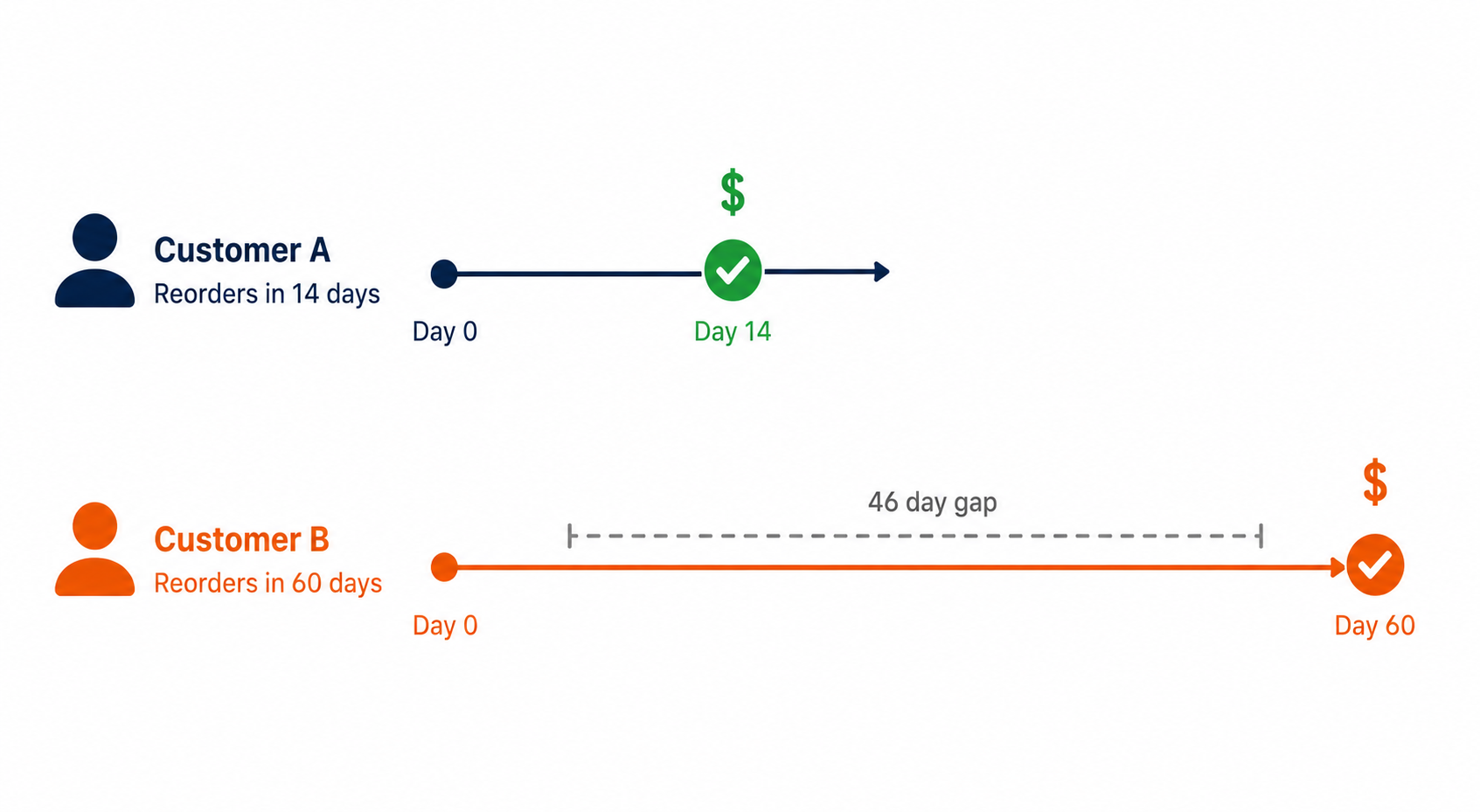
How long does it take your average customer to place a second order?
A lot of brands couldn’t tell you off the top of their head. They track LTV, open rates, revenue per email — all useful numbers in certain contexts, but all backward-looking.
By the time LTV drops, the customers causing the drop have already churned.
The time gap between order 1 and order 2 tells you where your retention is truly headed… before it gets there.
This is called retention velocity.
The faster/shorter your retention velocity, the better. A faster second sale means money in your pocket now instead of later. Money now is worth more than money later.
Furthermore…
Customers who come back quickly tend to keep coming back.
For example, a customer who reorders in 14 days is worth more over 12 months than one who takes 60 days, even if their first order was identical.
They pay you again sooner and they’re more likely to buy yet again in the future (and sooner in the future), since that faster retention velocity implies enthusiasm.
Today, we’ll look at what your retention velocity tells you, then cover a few ways to improve yours so you can improve cash flows and take advantage of revenue compounding.
| Table of Contents |
| What Your Retention Velocity is Telling You How to Accelerate Retention Velocity Make Them Buy Sooner And Compound Your Revenue What To Do Next |
What Your Retention Velocity is Telling You
By the time LTV drops, the damage is done. The customer has stopped buying, causing that longer time gap.
Retention velocity tells you what LTV will do beforehand, while you can act on it, by showing who’s buying repeatedly (higher potential LTV) and who hasn’t made it to order 2 (lower potential LTV).
So a long median reorder gap signals friction somewhere in the post-purchase experience.
The question is where.
It could be things like the:
- Product: Maybe it didn’t deliver results fast enough or to a sufficient degree
- Onboarding: The customer didn’t receive guidance on how to use it properly.
- Communication: The brand went quiet, and/or the customer service wasn’t helpful.
Or something else… but something’s stopping the customer from ordering again.
Segmenting by product or acquisition channel can reveal where the leak is.
If one product has a dramatically longer reorder gap than another, the friction is likely specific to that product’s experience.
If customers from one channel reorder faster than others, the acquisition source is telling you something about intent and fit.
How to Accelerate Retention Velocity
1. Know Your Customers Well
Improving your retention velocity starts (as many aspects of marketing strategy do) by knowing your customers.
Understanding their goals, problems, and purchasing behavior helps you select or identify back-end offers that are natural next steps for your customers.
Product usage cycles matter, too. Knowing how long your products last (if you sell consumables) helps you time sales messaging to their natural next-purchase moment (see Section 3).
The brands compounding sales and shortening retention velocity the most send the right offers to the right customers because they know who they’re selling to.
2. Nail the Post-Purchase Window
The customer’s order, the transaction, the exchange of money… That is NOT the finish line.
What happens in the days and weeks after the first order determines whether that customer comes back in 14 days or 60 — or doesn’t come back at all.
A solid Post-Purchase Sequence is the lynchpin. It onboards the customer properly by:
- Getting them excited about what they bought (overcome buyer’s remorse)
- Showing them how to use it (to achieve the result faster + appear helpful)
- Helping them get to a result as fast as possible
The faster a customer experiences the product working, the sooner they associate your brand with real results…
And the more they want to come back for the next order.
Beyond getting them to a result, the post-purchase sequence should do one more thing:
Set up the next purchase.
Whether that’s a cross-sell, replenishment reminder, or subscription push (some are discussed in this article), the best time to plant the seed for order 2 is during the customer’s order 1 honeymoon phase.
3. Encourage Them to Reorder/Refill
Ideally, you want order 2 to happen in the Post-Purchase sequence. Some will inevitably go through the whole thing without ordering, though.
The Replenishment Sequence is the next “net” to catch these people.
It triggers close to when they’d run out, letting them buy again and have it arrive before their current order runs out. That way, they can continue their routine without fail and without having to remember to reorder.
Past purchasers who haven’t reordered yet are one of the highest-converting segments for the same product since they know the product and have already bought… they just need a nudge.
Proof that consistency/regular use/consumption of your product is key. Testimonials or case studies demonstrating the benefits of long-term/regular use will increase Replenishment Flow conversions, shortening retention velocity.
4. Mail Your List Regularly
Once someone buys, they’re likely on your email list (either through the opt-in form or the purchase).
Beyond building the automated sequences mentioned, you should mail your list (most of which will be buyers) regularly.
Send mostly plain text emails with helpful content + offer. Work in fun/entertainment (storytelling, humor) where possible. Hold a promotion every so often, trying different types of offers (not just discounts).
Skip the HTML-only “SALE SALE SALE” billboard-style emails, except in specific circumstances (like promo announcements). Subscribers tend to ignore these because they look like ads (if they don’t land straight in spam/trash).
Unsubscribes will happen, especially if you’ve been quiet on email for a while. But do it right, and buyers will buy again as you shed subs who weren’t paying you (or planning to pay you) anyway.
(Not sure where to start with mailing your list? This resource will help.)
5. Push Them to A Continuity Offer
Continuity offers, such as subscribe & save and membership programs, remove the reorder decision entirely.
Instead of hoping customers come back, or only doing active outreach via emails and replenishment sequences, the next order is auto-scheduled.
The customer who converts to a subscription after order 1 essentially exits the retention velocity problem. Their reorder gap compresses to and stays at the subscription cadence.
(Still, you can attempt to sell them on shorter reorder windows. Perhaps they go through the product faster, share with family members, etc.)
That’s why getting a new customer onto a continuity offer as early as possible is one of the highest-leverage moves in your retention stack.
A Push to Continuity Flow automates this by sending to people who would be good candidates for the continuity offer.
For instance, I built a Push to Continuity Flow for an animal-based snacks brand. We sent it to anyone who had ordered the same product at least twice over all time (two orders is a stronger signal of subscription potential).
From there, you want to make them ascend the subscription ladder:
- Renewals: Get them to add something else as a one-off to their next order.
- Upgrades: Sell them on more of the same subscription.
- Expansions: Sell them on subscribing to a different product.
These moves don’t directly improve retention velocity (besides Expansions, which could do so by having the subscriptions hit at different times throughout the month)…
But they do deepen commitment to the brand, which reduces churn and increases the chance of between-subscription purchases.
Make Them Buy Sooner And Compound Your Revenue
The brands that win do not stop at purchase 1. They aim to get that second order as soon as possible, and then the third, fourth, ad infinitum.
Know your customers well enough to put the right offers in front of them. Nail the post-purchase window. Encourage the reorder before the moment passes. Show up consistently in the inbox…
And where possible, remove the reorder decision entirely with a continuity offer.
Do those things well, and the reorder gap shortens — meaning more cash comes in faster, compounding your earnings and customer lifetime value.
If you want the email sequences that make this happen (including a few discussed in this article) my free guide breaks down 10 email automations that can unlock an extra 10-15% in revenue for your store.
⇒ Get those 10 email automations here (they’re 100% free)
What To Do Next
- Share this article with someone who might find it helpful (or entertaining).
- Subscribe to my Substack to get these in your inbox every Friday.
- Learn 10 key email automations that unlock 10-15% more store revenue without extra ad spend.
- Grab my 21 best email templates/frameworks.
- Reach out to me at info(at)bradleyschnitzer.com if you have a sizable email list and make less than 20% of your revenue through email.