People like to complicate business growth.
Sure, it’s hard work. But the underpinnings of a successful business are simple.
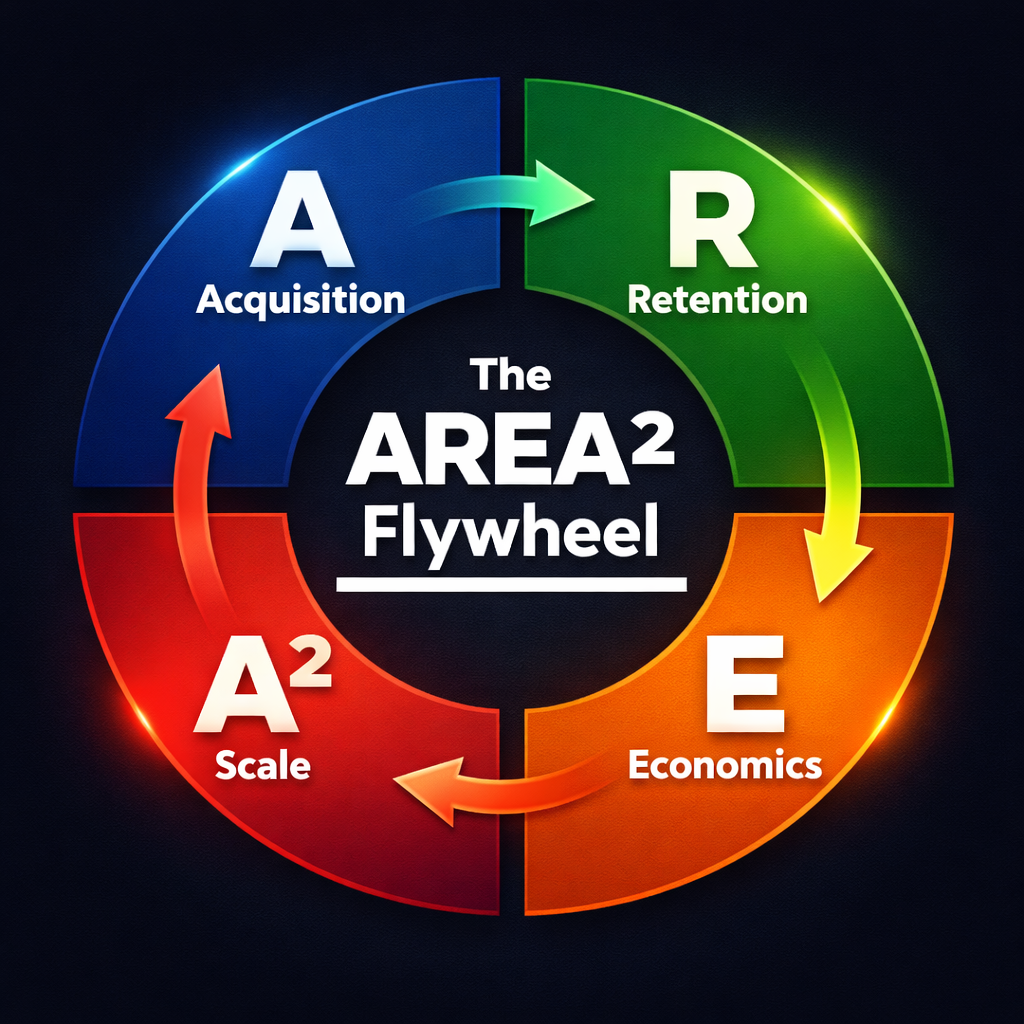
I call it the “AREA” flywheel:
- A(cquisition): Get customers.
- R(etention): Keep those customers.
- E(conomics): Make each customer more profitable.
- A2(cquisition): Reinvest to get even more customers.
Or, put horizontally:
A(cquisition) → R(etention) → E(conomics) → A2(cquisition)
Each step strengthens the next one.
Follow them sequentially, and growth (and scale, if you want that) becomes much easier to sustain.
Today, I want to show you each stage of this framework and the moves you make in each to move to the next stage.
We start with Acquisition…
| Table of Contents |
| A: Acquisition R: Retention E: Economics (Per Unit) A2: Acquisition2 (Scaling Stage) A Simple Flywheel = Incredible Growth What To Do Next |
A: Acquisition
Every business starts by needing customers.
That means picking a way to get in front of people who want to buy what you sell.
Tons of acquisition channels exist:
- Ads (Facebook, Twitter, Google, etc.)
- Newsletter ads (buying spots in people’s newsletters)
- Search Engine Optimization (SEO)
- Content marketing (overlaps with SEO)
- Social media
- Referrals (from others, usually better for service businesses/higher-ticket offers)
- Influencer marketing
- Affiliate marketing
- Partnerships
- Outbound sales (cold emails, cold calling, etc.)
Overwhelmed? Don’t be.
You should NOT try to do all or even most of them at once.
Pick 1-2 channels and learn them deeply. Test messaging, offers, audiences, and positioning until you find something that brings in customers.
Now, each offers tradeoffs.
Paid channels (primarily ads) save you a TON of time, but cost money.
Free channels (SEO, content, social media, etc.) help you do things on the cheap, but often take more time.
That’s why I say pick 1-2. Doing 1 paid and 1 free method is a good approach — paid for immediate results, free for long-term presence/brand-building.
For example, Facebook ads to drive sales now while you build a social media following or a library of SEO-optimized blog posts.
As for once they get to your site…
You need a front-end offer. This is something compelling (often your top-selling product + a limited-time incentive) to turn new visitors into buyers quickly.
Not everyone will buy immediately (especially if they find you through free channels), so set up an email opt-in to capture their contact info.
This lets you follow up later with email/SMS campaigns and certain email sequences, like your Welcome Sequence, to convert them.
Your goal is to turn traffic into a steady, repeatable system.
Once this system is running, you’ll have a steadily growing list of buyers and, by extension, more revenue.
Thus, you can move to Stage 2…
R: Retention
Obsessing over getting new customers while neglecting the ones you already paid to acquire is a mistake.
Once you have a steady customer acquisition system, the next step is to keep those customers.
After all, the easiest customer to sell to is someone who has already bought from you.
They know, like, and trust you.
And, by keeping them around, you can start to reduce dependence on the front end.
There are tons of ways to strengthen customer retention, but a few stand out:
- Email flows: Especially retention-focused sequences like your Post-Purchase, Replenishment, and Winback.
- Regular email campaigns and promotions: These keep customers engaged with your brand and give you opportunities to sell in every email.
- Subscription programs: Providing recurring delivery (such as through Subscribe & Save) encourages automatic repeat purchases and enhances customer satisfaction.
- Customer loyalty programs: These reward continued business by letting customers accumulate points or cashback redeemable for store products.
- Content: Content can serve retention, too. Customers stick around to learn your thoughts and mindset. For example, I worked with a golf instructor who, despite having a paid golf school and course, published a free weekly YouTube video that was a mainstay with his audience.
- Strong customer experience: Addressing complaints or questions promptly and non-defensively keeps customers who may otherwise leave and can turn negative experiences to positive ones.
Instead of letting customers drift away…
You continue communicating with them, solving new problems, and reminding them why they chose your brand in the first place.
You become more than “just another brand.” You begin to cultivate a sense of community and stick out in the customer’s mind.
A good example I love to tout is Good Ranchers.
This brand offers:
- A strong message/identity
- A subscription program with an incentive and perks
- A customer loyalty program
- Regular email campaigns
- Strategic email flows (like a Subscription Renewal email between every order)
- A sense of community (via package inserts and occasional social media challenges)
Lo and behold, I’ve been a customer since March 2022.
As your retention improves, you can move to (and sometimes simultaneously work on) Stage 3…
E: Economics (Per Unit)
Retention keeps customers around.
Economics focuses on making each customer more valuable.
Similar, but distinct.
Here, you’re aiming to improve the profitability of each customer relationship after the first purchase.
There are several ways to do this:
- Back-end offers: Additional products or offers you upsell/cross-sell that complement what your customers buy on the front-end.
- Boosting AOV: Bundles, product packs, strategic pricing tiers, and other new offer structures that encourage larger cart sizes.
- Price changes: Price increases or premium versions of products can improve margins while serving the same audience. They’re often necessary as costs increase. Here’s how to hike prices properly to avoid frustrating your customers.
- Subscriptions: A retention device that improves customer economics. Upsell their subscriptions into larger plans/amounts or expand them via cross-sells into complementary products. Critical for subscription-forward or subscription-only brands.
You could stop at Stage 3, and your business would do pretty damn well.
However, once you’ve improved your per-customer economics, something cool happens:
You have a lot more resources (capital) for the final stage of the flywheel…
A2: Acquisition2 (Scaling Stage)
Now we return to acquisition…
But this time, it’s different.
The first acquisition stage is about figuring things out — finding a channel, testing offers, learning what messaging resonates, and turning traffic into a repeatable system.
It’s more fragile. Budgets are tighter and you’re less experienced, so things go more slowly and mistakes hurt.
The second acquisition stage is about SCALING.
You now have two major advantages:
- You have cash: More revenue per customer (and customers sticking around longer) means more financial predictability and more capital to reinvest.
- You know what works: You’ve mastered your acquisition channels(s). Your messaging, offers, and funnels are already validated.
Most businesses try to scale acquisition before fixing retention and economics.
That’s where they break.
If every new customer barely covers their acquisition cost, scaling becomes risky. Growth stalls, or worse, it drains the business.
But when retention is strong and customer economics are healthy, the math flips in your favor.
Each new customer becomes fuel for the flywheel…
And that’s when growth really starts to accelerate.
One last thing:
You can try new channels here because:
- You’re in a stable position. Retention and customer economics are working, so you have time and money to experiment.
- You’re more experienced. After mastering your first acquisition channel, you know how to approach new ones.
- You can buy leverage. Courses, consultants, or specialists can help you get new channels running faster.
The key is to double down on your primary channel first.
Master it.
Then, start experimenting with additional channels.
If you successfully add even one or two more acquisition sources, your business becomes far more resilient and less dependent on any single traffic stream.
A Simple Flywheel = Incredible Growth
There’s a LOT you can do to move your business forward.
But ultimately, the structure underpinning real growth consists of 4 simple pieces:
- Acquire customers
- Keep those customers
- Increase each customer’s revenue and profitability
- Reinvest extra capital into acquiring more customers
Progress can feel slow at first while you figure out each stage.
But once the pieces are in place, each step reinforces the next…
And the wheel goes round and round.
What To Do Next
- Share this article with someone who might find it helpful (or entertaining).
- Subscribe to my Substack to get these in your inbox every Friday.
- Get my free eBook using the form below to learn the 5 things stopping you from turning “one-and-done” customers into repeat buyers.
- Grab my 21 best email templates/frameworks.
- Reach out to me at info(at)bradleyschnitzer.com if you have a sizable email list and make less than 20% of your revenue through email.