“I just don’t know what to write.”
I’ve heard this plenty, and not just from beginners.
Founders, marketers, and even I (occasionally) run into this problem…
But almost every time, I know it’s not true.
You encounter at least a dozen, if not several dozen, potential email ideas every day.
You simply lack a way to capture those ideas before they flutter away into the ether.
So today, I want to share the simplest system I know to never run out of email ideas again.
Why “Running Out of Ideas” is a Fake Problem
Ideas generally don’t show up on command.
You take in tons of information daily. Reading, hearing, seeing, noticing, conversing, and just living.
All this info seeps into your subconscious, which shuffles it around, causing thoughts and ideas to spring forth.
But then you get distracted…
And it’s gone as soon as it appeared.
So when it’s time to sit down and write, the idea well feels dry.
This is why “writer’s block” is usually misdiagnosed.
Most of the time, that “writer’s block” is a failure to capture all those raw materials your brain’s giving you.
The Idea Bank — The Only System You Need
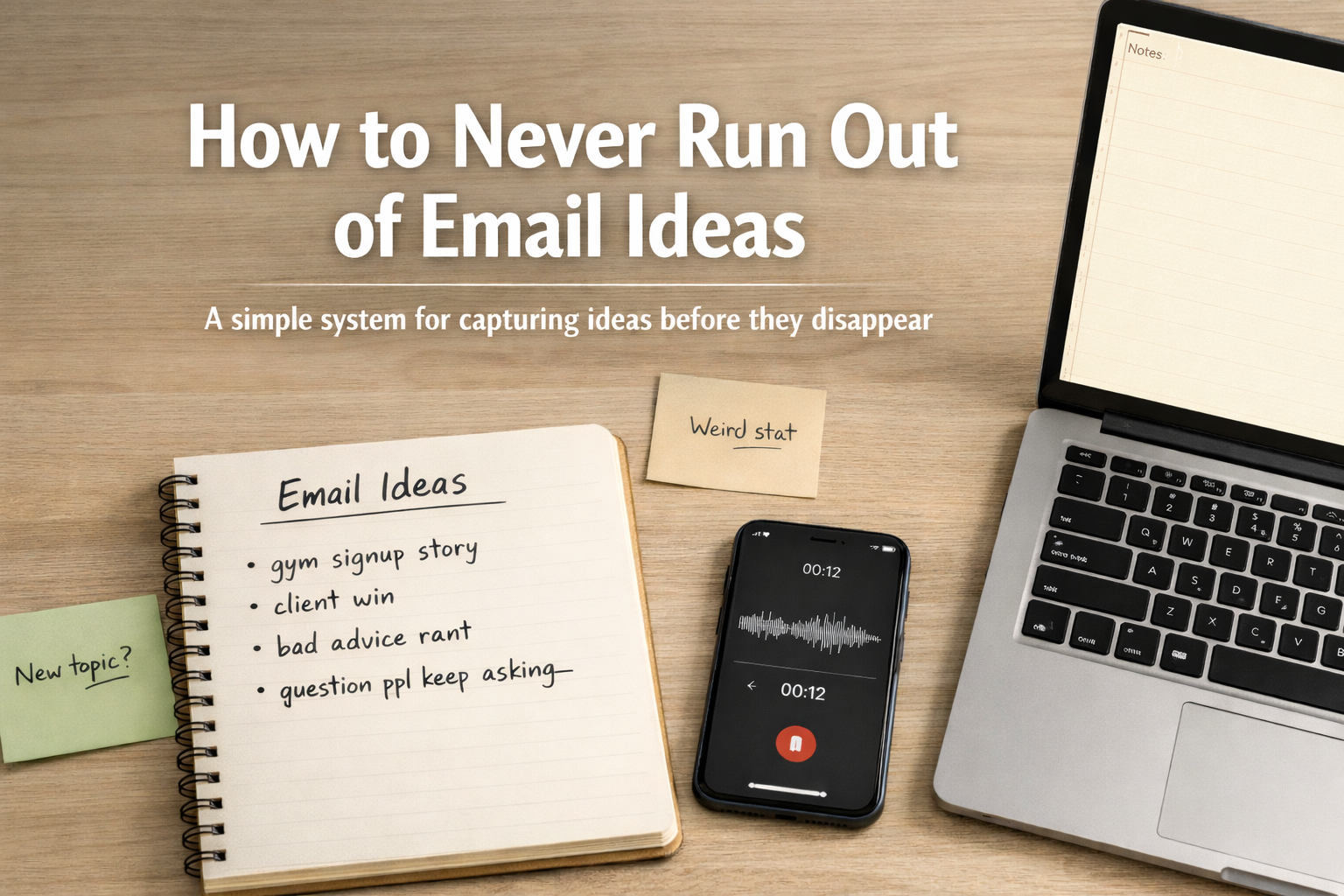
An idea bank is a place to store those random ideas.
The rule is simple:
Anytime something pings your brain, it goes into one place.
No need for a content calendar right now. That comes later.
For now, just create and maintain that idea bank.
It can be a Notion page, Google Doc, Apple Note — it really doesn’t matter. What matters is it’s easy to get to and always available.
A few guidelines that make this work:
- One running doc called something like “Email Ideas”
- Bullet points only
- One line per idea
- No formatting, structure, or polish
- Date optional
Don’t filter yourself. No asking “is this good enough?”
This is for your eyes only. Vague, messy, and half-formed is fine.
Trust me. I look back at unused ideas from months ago and cringe. But those might come in handy at some point.
Capturing Ideas When Not At Your Desk
Given that many ideas pop up when you’re not at your desk, you need easy, frictionless idea capture methods that work where you are.
A few options:
- Voice memos on your phone
- Voice-to-text notes
- Texting yourself
- Quick notes while walking or between sets (if it happens during exercise)
Again, messy is fine. The habit matters more than neatness.
Capture first. Clean later.
What to Add to Your Idea Bank
If you’re not sure what’s “worth” writing down, here are a few things that almost always turn into emails.
1. Everyday Stories
We’re wired for stories. Subscribers want to hear from you.
Put those together… and everyday stories make for endless content, even if they seem mundane to you.
See something mildly amusing happen while grocery shopping? Have an odd interaction at a coffee shop? Enjoy a great conversation with someone?
None of these sound like marketing ideas…
But there’s often an audience-relevant lesson (such as a false belief, mistake, or other insight) you can draw from them.
For instance, I wrote an email about my experience switching to a new gym.
Got a lesson about urgency and offer creation from it (the place had a limited-time near-$0 enrollment fee ending two days after I signed up).
2. Wins (You or Your Client)
Any wins you experience in your business are worth sharing.
Maybe you ran a killer launch campaign, or perhaps you uncovered a way to save your client thousands of dollars monthly.
The other upside is that these make you look better (especially if you’re sharing a client/customer win).
Screenshots and numbers help, but they aren’t necessary. Grab those later if you ever make a case study or something else.
For now, what matters is that you have a great story to share.
3. Failures/Mistakes
It can feel a bit scary to share failures and mistakes at first, but that’s what makes them more interesting.
Fewer people share them because they’re not glamorous and often embarrassing.
Thus, your readers receive valuable lessons they won’t find in polished case studies. You also create trust in your audience by demonstrating transparency.
A few failures might be:
- Campaigns that flopped
- Client deals you failed to close
- Clients that fired you
- Ideas that sound good that didn’t land
4. Industry Frustrations
What annoys you in your industry?
Bad advice? Stupid tactics? Slop content? Trends that people don’t understand?
Bet it annoys other people… and so writing about that will likely resonate with them.
These are fun because they feel good to write.
It’s often easier than you think to tie these to your product, too, since your product was built by you for a specific reason — against other products in the industry.
Pro tip: If you’re feeling bold, these can also make great social media posts. You might catch flak, but you’ll also get a lot of silent agreement (and even some “wow, thank you for saying that” DMs).
5. Predictions/Hot Takes
Any time you catch yourself thinking things like “Ah, this will lead to that…” or “Most brands are about to get this wrong…”
Write that down.
If you’re right, you look like a genius.
What if you’re wrong?
Refer to #3, Failures/Mistakes. Write an email showing why you believe you were wrong. Showing your work maintains customer trust by demonstrating transparency and still makes you look smart.
And hey, you look thoughtful and early if the prediction tracks given the information you had available.
6. Books/Blogs/Content You Enjoyed
This is one of my favorites.
If you’ve ever read a book/blog or watched a video and something jumped out at you, that’s an email waiting to be written.
That could be:
- Ideas that stood out
- Quotes that you underlined/saved
- Questions you asked after reading or watching
- Connections you drew to other things you’ve read or watched
It doesn’t have to be in your niche, either.
I’ve shared historical stories from books with my audience. Stories from the past often have business or copywriting insights within.
7. Things People Keep Asking You
Ah, the easiest one of all.
What do people keep asking you? For every one person that asks a question, several are wondering but haven’t asked.
Answer that question in an email.
Monitor these sources for common questions:
- Email replies
- DMs
- Client/customer questions
- Social media replies (if relevant)
- Content comments (videos, blog posts, etc.)
These questions are already-validated ideas. There’s no wondering if they’ll actually resonate.
Turning Raw Ideas Into Emails
Time to write… and the process is simple.
Open your idea bank, pick one, and expand it into an email.
Try not to get analysis paralysis over which idea to pick.
Either select the oldest (first in, first out, aka FIFO), or the most recent (last in, first out, aka LIFO).
(Have an idea come to you as you sit down to write? Use that instead. That’s one less idea to draw from the bank.)
Structure matters more than cleverness here. Stay on that one idea. Don’t dilute it with other ideas or readers lose the thread and lose interest.
Tools like ChatGPT are useful for expanding on/sharpening your core idea and cleaning things up if you give it the general idea and your thoughts.
My AI-Assisted Email Copywriting course teaches you how to do that — in a human-first, AI-second manner.
⇒ Learn more about AI-Assisted Email Copywriting
Never Run Out of Email Ideas
Email writers do NOT always invent ideas on command.
Instead, they’re paying attention to any fleeting idea, thought, observation, conversation, customer question, and so on…
And saving that raw material for later.
Once you build this habit, email consistency becomes mechanical. Neglecting email marketing is impossible.
That said…
The more you do this, and the more you write, the more often you’ll catch ideas as you sit down to write.
Part of that is because your subconscious’s ability to wrestle with the raw material and generate new ideas improves…
Which means you’ll hone your ability to write emails on the spot, allowing you to save more of your idea bank ideas — growing your “safety net” for those moments when the well runs dry.
No matter what, though…
You’ll never have to stare at a blank page wondering what to write about again.
PS: Good on ideas, but struggling to put words to paper? You need structure. My 21-Email Swipe Vault offers you my 21 best email templates, helping you plug your ideas into frameworks proven to sell. They also help spark email ideas. Learn more here.
What To Do Next
- Share this article with someone who might find it helpful (or entertaining).
- Subscribe to my Substack to get these in your inbox every Friday.
- Get my free eBook using the form below to learn the 5 things stopping you from turning “one-and-done” customers into repeat buyers.
- Grab my 21 best email templates/frameworks.
- Reach out to me if you have a sizable email list and make less than 20% of your revenue through email.