Whenever I shop for something that isn’t gas or groceries, I’m always looking for something:
A guarantee that protects me from downside if the product isn’t for me.
Maybe it’s the wrong size, doesn’t serve my needs, or just doesn’t work well.
Regardless, most customers are risk-averse in this sense.
And sometimes, that fear is what keeps a customer from buying…
Even when their credit card is out of their wallet and ready to go.
Enter:
The humble “risk reversal.”
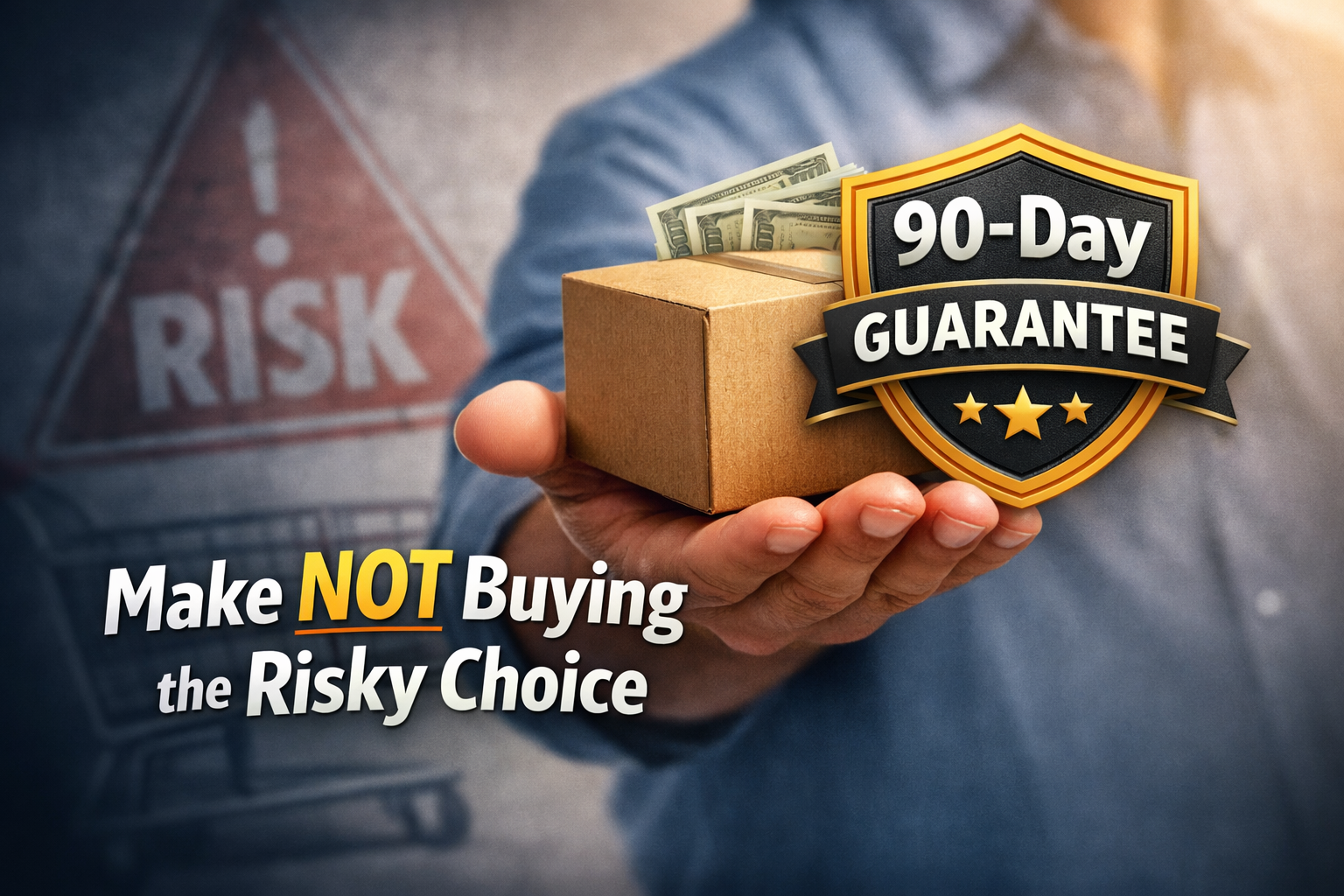
Risk reversals make it silly NOT to buy since, as the name implies, you remove the risk.
Let’s talk about what these are, how they work, and why they aren’t as risky to you as you might think…
| Table of Contents |
| What is a Risk Reversal? Types of Risk Reversals Where Do I Include Risk Reversals? Make Saying “Yes” A No-Brainer What to Do Next |
What is a Risk Reversal?
A risk reversal dramatically reduces or eliminates the potential downside of buying by helping the customer experience the product while protecting from loss.
For example: “If you don’t like it, return within 90 days for a full refund.”
See?
You bear the risk for them.
This doesn’t just make it easier for the customer to buy, though.
By bearing the risk, you’re demonstrating confidence in your product.
That alone tells the customer that your product is good. You wouldn’t take such a risk if you actually had to redeem the risk reversals (refunds, returns, etc).
Which is why the best brands tend to offer excellent risk reversals.
NOT buying now feels like a stupid move.
Crucially:
This happens without you lowering your price. No cheapening your product here.
A crucial element of a good risk reversal is ease. If it’s hard to redeem it — whether by making the terms difficult or by placing a burden on the customer — it won’t feel as helpful.
For instance, if a customer needs to return something, providing a prepaid shipping label helps.
Heck, if you cover return shipping, that’s even better.
Won’t I Lose Money?
In theory, yes. In practice, no… if you have a good product that delivers results and half-decent customers.
A good product that delivers results is something that customers will want to keep.
I mean, if a supplement helps me lift more, why would I want my money back (if that’s the risk reversal)?
Or if I get a free bottle (after only paying shipping), why would I want to stop after getting results?
Freebie seekers may take advantage of your risk reversals (and even then, not all of them).
But you don’t want freebie seekers in the first place. That’s a separate problem. These people wouldn’t buy from you much anyway.
Bearing that risk is the point.
However:
If you stand behind your product and know it delivers… and your audience consists of normal, good people…
That’s a risk worth taking given what we’ve laid out here.
So let’s explore the types of risk reversals…
Types of Risk Reversals
1. Moneyback Guarantee
The moneyback guarantee, also known as a refund guarantee, is one of the most basic risk reversals imaginable.
It promises to give the customer a full refund if they aren’t satisfied, removing financial risk — one of the biggest mental blockers for many buyers.
But a lot of brands get timid here:
- Short guarantee windows
- Fine print everywhere
- Language that feels defensive
These neuter the guarantee by:
- Making it the terms arbitrarily harder to meet
- Making the customer feel like you’re trying to avoid making good on guarantees
Instead, a good moneyback guarantee is generous, confident, and… boring:
“If you don’t like it, get your money back. No hassle.”
All that said…
You can, and often should, still set conditions. The most common is a generous time window, like 90 days, but the length varies by industry.
That alone is often enough for many physical products.
But there are others.
For instance, course creators often let you redeem the guarantee as long as you prove you completed X% of the lessons.
This helps screen out freebie seekers — no reasonable person would object to this.
2. Replacement
Replacements are another simple risk reversal, generally suited to nonconsumables.
You’re telling the customer that if they don’t like the product, or this particular item isn’t for them, or it arrives damaged, they can swap it out for another one.
This works especially well for physical products where the fear isn’t performance yet. Rather, this alleviates worries around:
- Damage
- Defects
- Shipping issues
- Durability concerns
- Sizing/fit
Just look at almost any clothing brand. Good chance they have a policy like “return for a replacement within 90 days” or similar.
That might translate into a replacement or store credit the customer can spend.
The one downside here is that sometimes, customers want their money back.
The moneyback guarantee/refund may work better in many cases.
3. Refund + Bonus
Refund + bonus makes a refund guarantee deal even more outrageous — in a good way — by offering something on top of the refund.
That could be:
- The product itself
- A bonus
- A store credit
- An add-on
Yes, this is riskier.
But again, audience targeting + product quality reduces said risk.
Good customers don’t aim to take advantage of your generosity.
4. Free Trial
Free trials remove financial risk, but also commitment risk.
These work best for products that dispel customer skepticism upon use — especially experiential products.
A good free trial delivers a “quick win” and makes continuing with a paid plan feel logical and easy.
Many businesses require payment methods for free trials. Increase the likelihood of converting to a paid subscription since the plan rolls over automatically.
I don’t have a problem with this. It depends on where you want to deal with sales friction.
Requiring a card for a free trial causes friction early by removing friction later (free trial rolls into paid subscription).
NOT requiring a card removes friction now, but they must manually sign up for a paid subscription.
Now, free trials aren’t just for SaaS or online communities.
Anything with a subscription, including brick-and-mortar businesses, can do it.
EōS Fitness, a gym I just joined, offers an excellent example:

I can try the gym free for 7 days — no credit card required.
That means I could get 3-4 workouts in without paying a penny…
And not have to worry about auto-enrolling in a membership (which is already dirt-cheap anyway).
Of course I’m gonna sign up!
(Funny enough: It was the last week of enrolling for just $0.26 instead of $149 so I joined the same day I activated the free pass. Lesson in there.)
The gym is great. This guarantee backs that up. The gym is confident I’ll love the place and want to sign up for a membership.
NOTE: As I was writing this, I got an email from a brand for a “pay just $1 for your first order” offer.
This works the same way since $1 is effectively free.
Yet it’s a “microcommitment” that increases the likelihood the customer uses the product and orders again.
In a way, it normalizes paying for your product.
5. Performance-Based Guarantee
A performance-based guarantee guarantees an outcome rather than satisfaction.
It’s one of the riskiest for you if done poorly, but that means customers have almost no risk.
It can almost make the offer feel unfair (in a good way).
The key here is tight control over several variables:
- The outcome must be measurable
- The customer must follow clear rules
- The guarantee must be specific
Furthermore, you must dial your audience in almost perfectly.
If you aren’t screening for the right customers, there’s a good chance you end up with someone who you structurally can’t deliver for…
Wasting a ton of your time and resources.
You’ve seen this one before in the field of law:
“We win your case or you don’t pay.”
Those lawyers aren’t going to take just anyone. They’ll take clients they are highly confident they can win for.
This is good for the lawyer’s client.
It forces the lawyer only to take clients they can help…
And motivates them to work their ass off for the client.
Other examples:
- Lose X pounds or get your money back
- Increase conversion by Y%, or we refund you
- If you don’t see results by Z, you don’t pay
Regardless, these incentivize you to find the best kinds of customers and make buying a no-brainer.
NOTE: You must have proof to back this up. There’s a meme about beginner copywriters who say, “Hire me, and I’ll do XYZ, or you won’t pay!” Problem is, the business owner spends time and sometimes money to hire you, even if they don’t pay you directly.
So this works better for experienced professionals, highly proven products, and, frankly, certain industries.
6. Extended Warranties
Extended warranties cover certain damage or defects for a long period after purchase, reducing long-term risk.
It works best on higher-priced products (generally, at least $100), especially when tied to durability and performance.
But warranties aren’t about protecting the customer as much as reassuring them that the product will work.
That’s why car companies like Hyundai offer 10-year, 100,000-mile powertrain warranties.
That tells customers “this company is so confident in their cars’ powertrains, they’re willing to cover certain things a decade from now.”
Cars aren’t the only warranty-viable product.
I worked with a sports equipment brand whose main selling point was ease of use and insane durability. It offered a strong warranty on most products.
Such a warranty reinforces to athletes, parents, and coaches that this product, used properly, will hold up over lots of reps over the long term.
Done right, warranties don’t necessarily increase support issues… but they do reassure the customer at the moment of purchase.
7. Pause/Cancel Anytime Guarantees
This risk-reversal removes lock-in worries, a common hesitation around subscriptions.
Even if the product is good, customers want an easy exit if possible.
However, you don’t want to make them jump through hoops or hide obstacles in fine print. This creates resentment and reduces your chances of recovering them.
Ironically, flexibility here creates retention.
Heart & Soil is great here. Look under the “Subscribe Now” button:

The first thing — even before the discount reminder — is the “no commitment” line.
They make good on that:

I can delay shipments by 1 week (or go back to the previous screen to delay up to 4 weeks), or click edit to change delivery intervals or cancel.

I like the “swap to try a new product.” Nice way to reduce cancellations without limiting flexibility.
Where Do I Include Risk Reversals?
You can add these to several places:
- Email messaging in broadcasts and flows (aka emphasize it occasionally)
- Renewal emails for subscription products
- A standard footer block in your template (so it appears in every email)
- Product pages
- Home and about pages
- FAQs
- Product packaging (on the packaging or with the product, such as a card)
The more places you include it, and the clearer it is, the more customers appreciate it.
(Comment if you have any other ideas for where you could highlight risk reversals. I’d love to hear them.)
Make Saying “Yes” A No-Brainer
The more risk a customer bears, the more they hesitate.
When you take that risk on, hesitation looks silly. Not just because the customer has protection against downside…
But the very fact you bear their risk tells them you stand by your product and the results it promises to deliver.
Yet proper audience targeting + good customer service minimizes the number of risk reversals you must redeem.
Think about what you can do to reduce customer risk. If you’ve honed your messaging and dialed in aspects of your front-end marketing, this is the next move you can make to increase conversions.
What To Do Next
- Share this article with someone who might find it helpful (or entertaining).
- Subscribe to my Substack to get these in your inbox every Friday.
- Get my free eBook using the form below to learn the 5 things stopping you from turning “one-and-done” customers into repeat buyers.
- Grab my 21 best email templates/frameworks.
- Reach out to me if you have a sizable email list and make less than 20% of your revenue through email.