A business cannot live on lead gen alone. The moment someone buys, you want to move them toward that second purchase (and then third, fourth, etc.).
The Post-Purchase Flow is THE engine for this. It sends to anyone who buys, with many goals — the ultimate being to make the customer place their next order.
However, stopping at a single, generic Post-Purchase Flow leaves a LOT of money on the table…
Both in terms of raw sales AND customer loyalty.
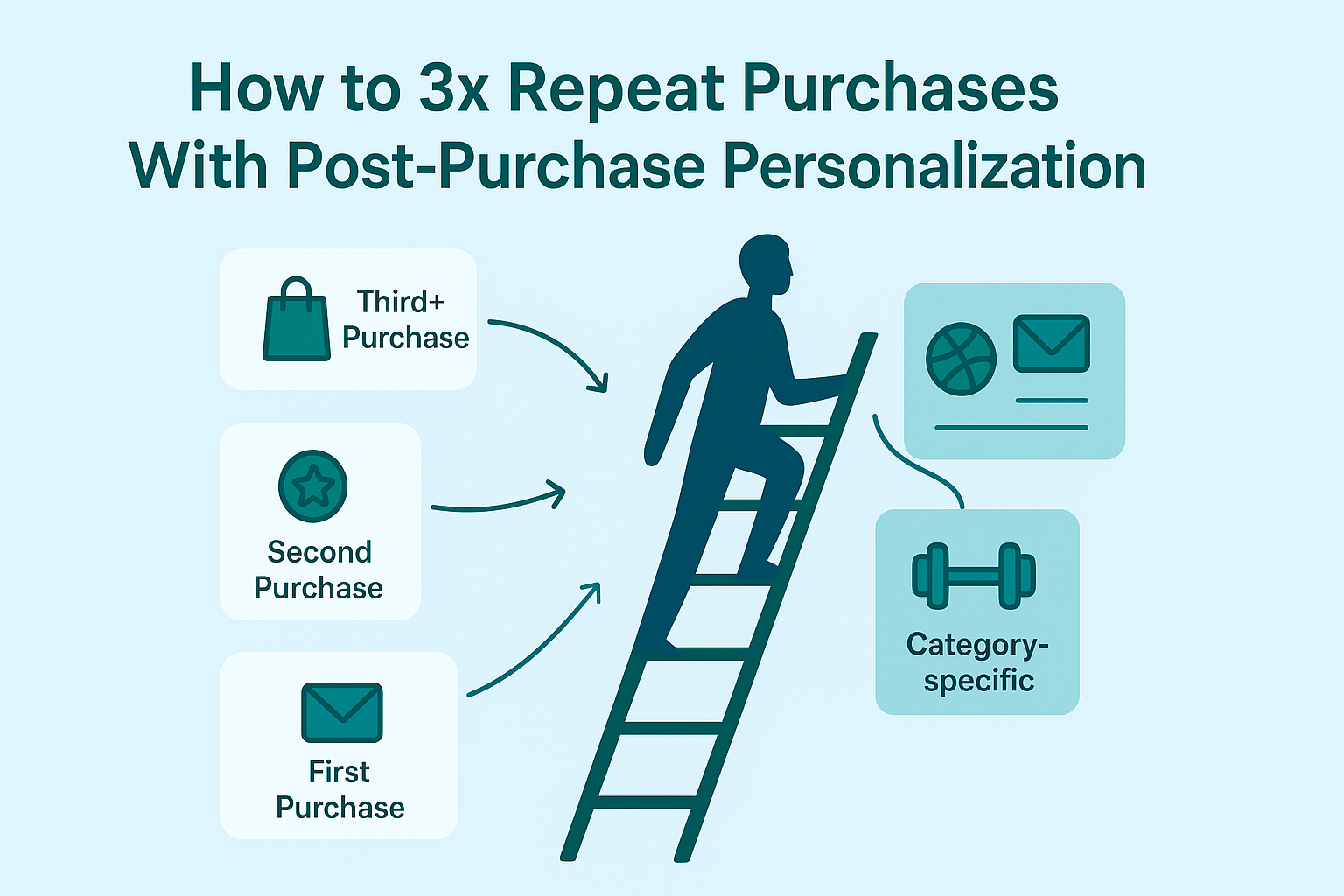
What you need is “Post-Purchase Personalization”. In other words, building branches/flows that tailor messaging to customers based on the number of purchases and category purchased from.
That’s what we’ll cover in this article.
| Table of Contents |
| Purchase Count Category/Item Purchased Putting It Together Other Flows – Replenishment and Winback Multiply Your Repeat Purchases… Multiply Your Profits What To Do Next |
Purchase Count
“Purchase count” refers to the number of times a customer’s placed an order with you.
A brand new buyer differs dramatically from a repeat customer. Second-time buyers differ from third-time buyers, too, albeit less.
Each responds best to different kinds of messaging.
Some elements will overlap (order/shipping confirmations, general product usage tips), and they’ll follow the same post-purchase structure, but they won’t be the same.
By doing this, you create a “ladder” of sorts. Customers are more likely to buy in each branch, ascending to the next branch, and then buy again.
Hence, a higher chance at repeat orders.
Let’s look at each purchase count tier to see what I mean.
First Purchase
The first purchase branch is the “onboarding” branch. It’s where the one-off customer turns into a repeat buyer (and sometimes, a long-term loyalist).
Messaging is all about thanking them for taking that first step toward being part of your community and
At this stage, you’ll:
- Welcome them to the brand
- Get them hyped for their product
- Encourage them to explore other aspects of your company (about page, FAQs, social media, etc.)
- Help them score a WIN with their product
- Gather a review (some brands wait until the second purchase)
- Lead them to the next logical purchase via upsell/cross-sell
On that last bullet… the next logical purchase varies by brand.
If you only sell one product, it’s pretty obvious what to do next.
Consumable brands can either sell them on a refill (if the upsell is near the end) or cross-sell to a complementary category (if earlier in the flow).
For instance, I had a CBD brand recommend the best product in their other three categories.
You’ll have to think about this part a bit. Like I said, it depends on your brand.
Second Purchase
If the first-purchase branch didn’t convert them to a long-term customer, the second-purchase branch is your chance.
This branch welcomes back those customers who made a second purchase and thanks them for their continued support.
Much of the same ground is covered. This is because they may not have explored everything about the brand yet, and, at the end of the day, you’re still providing a similar “post-purchase experience.”
But the messaging changes a bit. It’s more about reminding them of why they chose you and the wonderful results they’ve experienced already…
Cementing loyalty by seeding the idea of sticking with the brand for continued results.
As for getting the next purchase…
They’re more loyal here. So you don’t need the low hanging fruit of “buying the same product they already trust.”
Focus on getting a different kind of purchase. That could be a larger/better version of the original product, or it could be a complementary category.
Doing so will achieve a bigger “customer win” AND will get them more invested in the brand.
Have an affiliate program? Maybe a wholesale program? Ambassadorship? Gift cards?
Second branch is a good spot to introduce a few of those. I’d lean toward a gift card first since the others are more “loyalty-coded.”
Third Purchase and Beyond
Loyalty is often cemented by order #3. So the third-purchase branch is where you continue to communicate with them, thanking them for being so supportive.
You can have this branch send for ANY number of purchases 3 or more since they are “at the top of the ladder” so to speak. Make sure the copy is standardized (ex: “Whether it’s your third order or your thirtieth…”).
Light “VIP” style messaging works here.
Show them that they are among the elite of your customers.
Explain that customers like them make the brand’s mission, product quality, etc. possible.
Reiterate the benefits of the product while framing it as “thank you for supporting us”.
Here is the best spot to introduce things like:
- Affiliate program: Gain a network of affiliates who sell your stuff for you to loyal audiences, boosting revenues with ease.
- Ambassadorship: Get good people to represent your stuff (similar to an affiliate program).
- Wholesale program: Skyrocket cash flows with just a few B2B buyers.
Your loyalest customers are likely to be more niche-invested. So these could be a good fit.
For instance, say you’re a supplement brand. A customer has ordered from you 10 times. There’s a non-zero chance this is a(n):
- Influencer (good for ambassadorships)
- Niche content creator (good for affiliate programs)
- Personal trainer (good for affiliates or ambassadors)
- Gym owner or someone who knows one (wholesale opportunity)
Again, I did this with a CBD brand. We invited massage therapists, content creators, and relevant businesses to explore these programs.
Category/Item Purchased
The other aspect of personalization is the category/item purchased.
Pretty obvious. Different item categories address different problems/goals. They have different uses and tips for maximizing their benefits.
Category Branches
Each branch is for customers who bought from a SPECIFIC CATEGORY X number of times.
It should ONLY be for that category.
Say you have product Categories A-E. Someone buys from Category A only. Set up simple filters that screen out anyone who buys from Category B or C or D or E.
Rinse and repeat for the other categories.
As for copy…
The copy should speak to several things specific to the category:
- Customer problems
- Customer goals
- Usage tips
- Relevant cross-sells within the category
The “General” Branch
You don’t want people who buy from multiple categories in one order to get two category branches at once.
But you also don’t want to skip them entirely.
The “general” branch solves this problem. It sends to anyone who buys from two or more categories.
The language here is, as the name implies, more general. You don’t want to target a specific category — it’ll sound odd that you’re excluding the OTHER category from which they bought.
Keep it more about the general problems your product solves, broader usage tips, and so on.
For instance, you sell gym equipment. Someone buys weight plates but also some lifting chalk. You’d send them the general branch.
The language would be more about getting good workouts in with the right equipment, rather than focusing specifically on how to use the chalk or care for weight plates specifically.
A good way to keep some personalization is to link to FAQs or educational resources that then LET them find their product/category.
Putting It Together
All together, you should have a flow for every category, each with three branches:
- 1 order from that specific category
- 2 orders from that specific category
- 3 orders and beyond from that specific category
For example, take a sports gear brand. A customer’s first order ever at the brand is a soccer ball.
They get the soccer ball post-purchase branch 1. 20 days later, they buy a soccer goal.
They get the soccer ball post-purchase branch 1. 20 days later, they buy a volleyball net (perhaps they have a volleyball player in the household, too.)
Now, they get the volleyball post-purchase branch ONE.
Crucial to filter this way. It would not make sense to send them “repeat purchase” messaging for volleyball gear when they placed their first volleyball order.
As for building the flows…
I like to build the category flow for the top-selling category first. Branches, copy, everything. Then I can clone that flow for all my product categories.
The only task left after that is tweaking the copy to fit each category and messing with the flow name.
It’s the most efficient method.
You CAN try to build one giant flow with everything in it. But that means multiple branches, tons of split logic, cloning individual emails a million times, etc.
That takes a long time, makes the flow messy, and leaves tons of room for error. Easier to do my flow cloning method.
Other Flows – Replenishment and Winback
I recommend NOT personalizing Replenishment or Winback flows by purchase count right away.
These flows see less action since they only trigger IF someone hasn’t somehow made a second purchase.
And when you’re running a full-blown email marketing strategy, most people WILL buy again off your post-purchase OR regular broadcasts/promos.
The ROI isn’t there. More substantive copy changes are needed between first, second, and third+ purchases to speak to each customer properly.
Therefore, build branches/flows for category/item personalization done first. Then build out all your other flows (including front-end ones).
Only after, if you find some spare time, build the purchase count personalization branches for Replenishment and Winback.
Multiply Your Repeat Purchases… Multiply Your Profits
A generic Post-Purchase flow will do something, but that’s like 10% the potential of a true Post-Purchase system.
Build branches for purchase count. And build flows for category-level personalization.
This will create a more comprehensive “experience” with your brand. It will feel to the customer a bit more like you care and are speaking to them specifically.
You’ll stand out in a sea of mediocre marketing… and be rewarded with repeat business and customer loyalty.
What To Do Next
- Share this article with someone who might find it helpful (or entertaining).
- Get my free eBook using the form below to learn the 5 things stopping you from turning “one-and-done” customers into repeat buyers.
- Reach out to me if you have a sizable email list and make less than 20% of your revenue through email.
1 Reply to “How to 3x Repeat Purchases With “Post-Purchase Personalization””
Comments are closed.