I was reading this excellent post by Alexander Cortes the other day about creatine’s essential role in American reindustrialization.
(Go read it if you’re interested in American reindustrialization/supply chain sovereignty.)
The short version:
China manufactures most of the world’s creatine, but doesn’t care about “serving athletes and gym bros.”
See, there’s a key intermediate chemical critical to agriculture, pharmaceuticals, plastics, electronics, explosives, and more…
Things China wants.
But the infrastructure needed to create it is expensive. It needs insane production volume to justify the cost.
And making creatine — which has high demand in the wealthy West — requires TONS of this chemical.
China built the infrastructure, sold a lot for creatine purposes, and funneled the remainder into other applications.
That’s a national security and supply chain story. But it’s also a business lesson.
Infrastructure is expensive in time, money, or both. It can limit you from creating the real thing you want to sell.
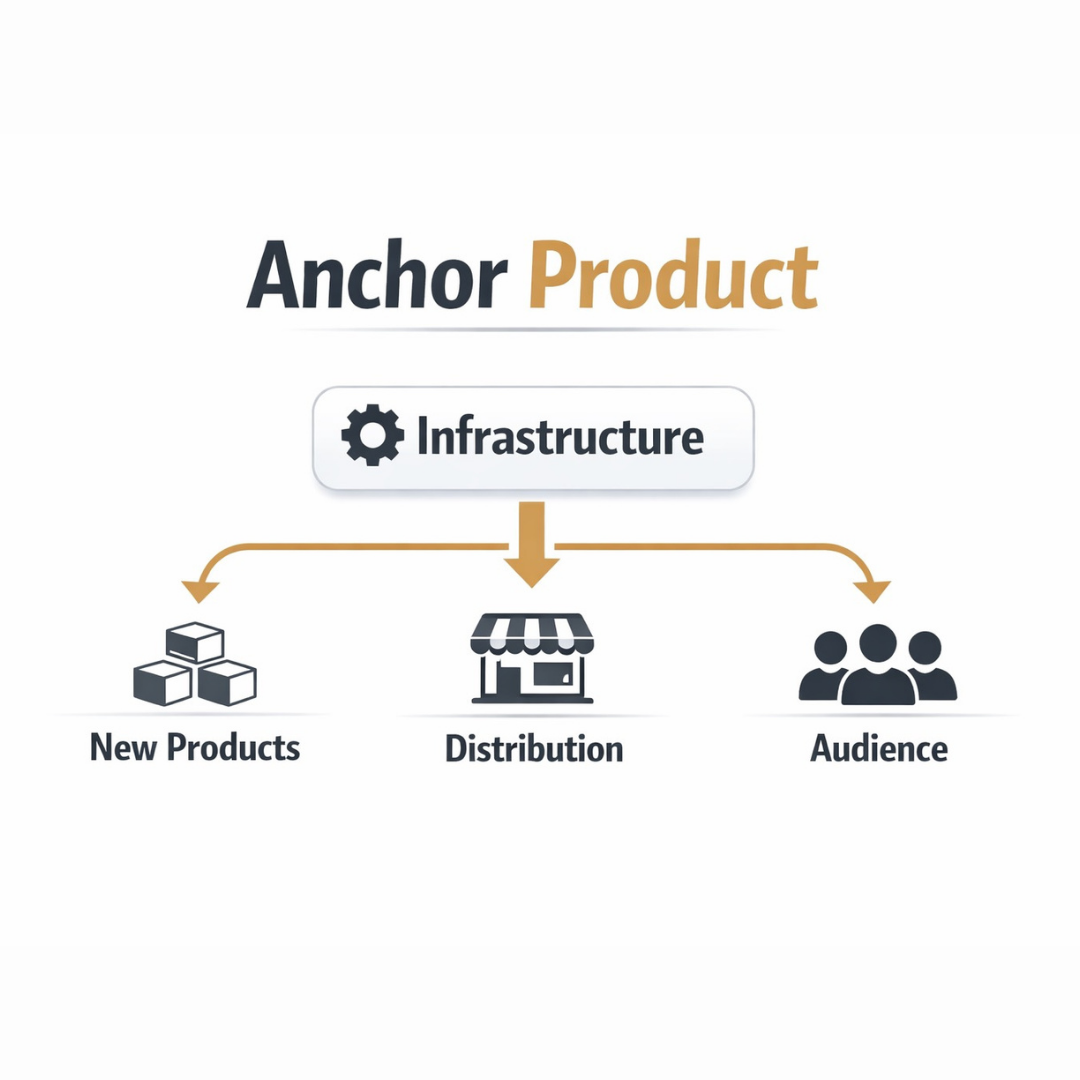
Creatine here is what I call the “anchor product.” It helps build the infrastructure necessary for the real things you want to do in your business.
In this article, we’re going to discuss why you may need one, plus a few historical and personal examples.
| Table of Contents |
| The Product That Pays For (And Creates) The Machine What the Machine Actually Is A Few Examples Build One Product, Fuel the Machine What To Do Next |
The Product That Pays For (And Creates) The Machine
An anchor product is a single, high-demand offer that generates enough volume to fund your business infrastructure — and financially justifies building it in the first place.
The keyword there is “justifies.”
Infrastructure has fixed costs. Those costs don’t care whether you’re selling one product or ten.
But a high-volume product spreads those costs across enough units that the math starts working in your favor.
Suddenly, the warehouse, systems, team, and distribution make financial sense.
And once it exists, the machine you created doesn’t just serve the anchor product anymore.
It’s available for everything else you want to build:
- New products
- New offers
- New lines of business
They all get to skip the hard part because the foundation is already there.
Your anchor product often becomes your hero product, useful for a front-end offer, given its propensity to make sales.
The other products you launch later complement it as back-end upsells and cross-sells.
Why Most Businesses Get This Backward
Many founders start by asking the wrong question.
They ask, “What should I sell?” and then try to build a business around whatever answer comes up.
Sometimes that’s a niche product they’re passionate about. Sometimes it’s the “perfect” offer they spent months refining. Sometimes it’s just a small idea they wanted to test.
Nothing wrong with any of that, necessarily.
But none of those questions gets at the more important one:
What can actually fund the system?
Without that answer, you might build a decent product. You might even build a profitable one.
You’ll likely never build the infrastructure underneath it that turns a single product into a real, expandable business, though.
The anchor product thinking flips the question.
Instead of starting with the product and hoping the business follows, you start with what the business needs — and find the product that can pay for it.
What the Machine Actually Is
When I say “infrastructure,” I don’t mean anything abstract.
I mean specific, tangible things that make a business run and scale:
- Systems: Your operational backbone — order fulfillment, customer service, inventory management, software platforms, and so on. The repeatable processes that don’t require you to reinvent the wheel every time.
- Distribution: Your ability to get products in front of people. It’s your ad channels, email marketing, retail relationships, wholesale accounts, etc. Once built, distribution serves every product you run through it.
- Audience: Arguably your most valuable asset. A loyal, engaged customer base that trusts you doesn’t just buy one product. They buy repeatedly because they already know you. It can also be your social following, email list, loyal blog readers, and so on, even if they have not bought yet.
- Processes: How your team executes consistently. Sourcing, production, quality control, launches, etc. The difference between a business that scales and one that breaks under pressure often comes down to whether these are documented and repeatable.
- Capital: Money in the business creates options. It funds new product development, marketing, hiring, and experimentation without putting the whole operation at risk.
- Skill stack: What your team knows how to do, whether that’s manufacturing, marketing, logistics, or copywriting. Skills compound. What you learn building the first product makes the second one faster and cheaper to launch.
Nothing glamorous here. But these underpin good businesses and separate a single-product operation from a company aiming to expand.
A Few Examples
I covered the Chinese creatine example at the start of this article, but let’s look at some other examples:
Oil Didn’t Start With Gasoline
When Rockefeller built Standard Oil, the primary product wasn’t gasoline…
It was kerosene, used for lighting lamps before electricity became widespread.
There was a massive demand for kerosene.
That demand justified building the refineries, pipelines, distribution networks, and storage infrastructure.
It funded the entire machine because there were enough customers who needed it in large enough quantities to effectively “guarantee” a return on the investment.
Then, the automobile came along.
Suddenly, Standard Oil had something most competitors couldn’t replicate overnight:
An already-built infrastructure capable of processing and distributing fuel at scale.
Gasoline became the dominant product, and kerosene lost importance due to electricity, but the machine that delivered it existed because of kerosene.
And, funny enough, in this case, it was almost an accident.
Imagine if Rockefeller had NOT tried to sate kerosene demand.
The gas-powered automobile may not have been possible at scale.
Personal Computers Funded Semiconductor Fabs
Those fabs now produce chips for everything from cars to satellites.
Early PC manufacturers needed LOTS of chips.
The only way to get chips reliably and cheaply was to build the fabrication plants yourself.
Those fabs were enormously expensive to build, but the volume demand from personal computers financially justified the investment.
So companies built them.
Yet they did NOT end up merely with a way to make PC chips. The infrastructure provided manufacturing capability for semiconductors used in cars, satellites, medical devices, military technology, and virtually everything else that runs on a processor.
The PC was the harbinger of the modern age…
And not just in the world of atoms, but in the world of bits.
My First Offer Was NOT Just an Offer
For a long time, I just did client work.
Learning how to get clients, writing emails for those clients, building retention systems, running promotions, assisting with offer structure…
Yes, I was building a service business. But, by accident, I was building something else at the same time:
The infrastructure, with my client work serving as the anchor product.
Client work:
- Funded the capital I needed to invest in software, tools, and eventually a proper platform to manage my products
- It built my skill stack — email marketing, AI-assisted writing, offer structure, campaign strategy — by giving me something credible to talk about and a reason for people to follow along
- It developed my processes, because delivering consistent work for clients means figuring out how to do things in a repeatable, reliable way
- It built my distribution, a network of people in my industry (many with their own email lists) who were willing to promote what I eventually launched.
None of that existed before the client work. All of it came from it.
So when I eventually launched AI-Assisted Email Copywriting, I had already built the machine. The product just had to run through it.
After that, my 21-Email Swipe Vault and Perfect Price Hike Formula products were even easier to launch.
The latter is a more niche product, so it would NOT work well as an anchor…
Hence why the infrastructure built from my services is necessary.
Build One Product, Fuel the Machine
China didn’t set out to corner the creatine market.
Rockefeller didn’t build an empire around lamp fuel.
I didn’t spend years doing client work just to run a service-only business forever (although I may have clients for the rest of my time in this business).
But in each case, the anchor product did its job. It built the machine.
The rest followed.
So you don’t need the perfect product or even the most interesting. Launch something with enough demand to fund and create the infrastructure that makes the rest of it possible.
The true passion can come later when the business is humming along.
What To Do Next
- Share this article with someone who might find it helpful (or entertaining).
- Subscribe to my Substack to get these in your inbox every Friday.
- Get my free eBook using the form below to learn the 5 things stopping you from turning “one-and-done” customers into repeat buyers.
- Grab my 21 best email templates/frameworks.
- Reach out to me at info(at)bradleyschnitzer.com if you have a sizable email list and make less than 20% of your revenue through email.