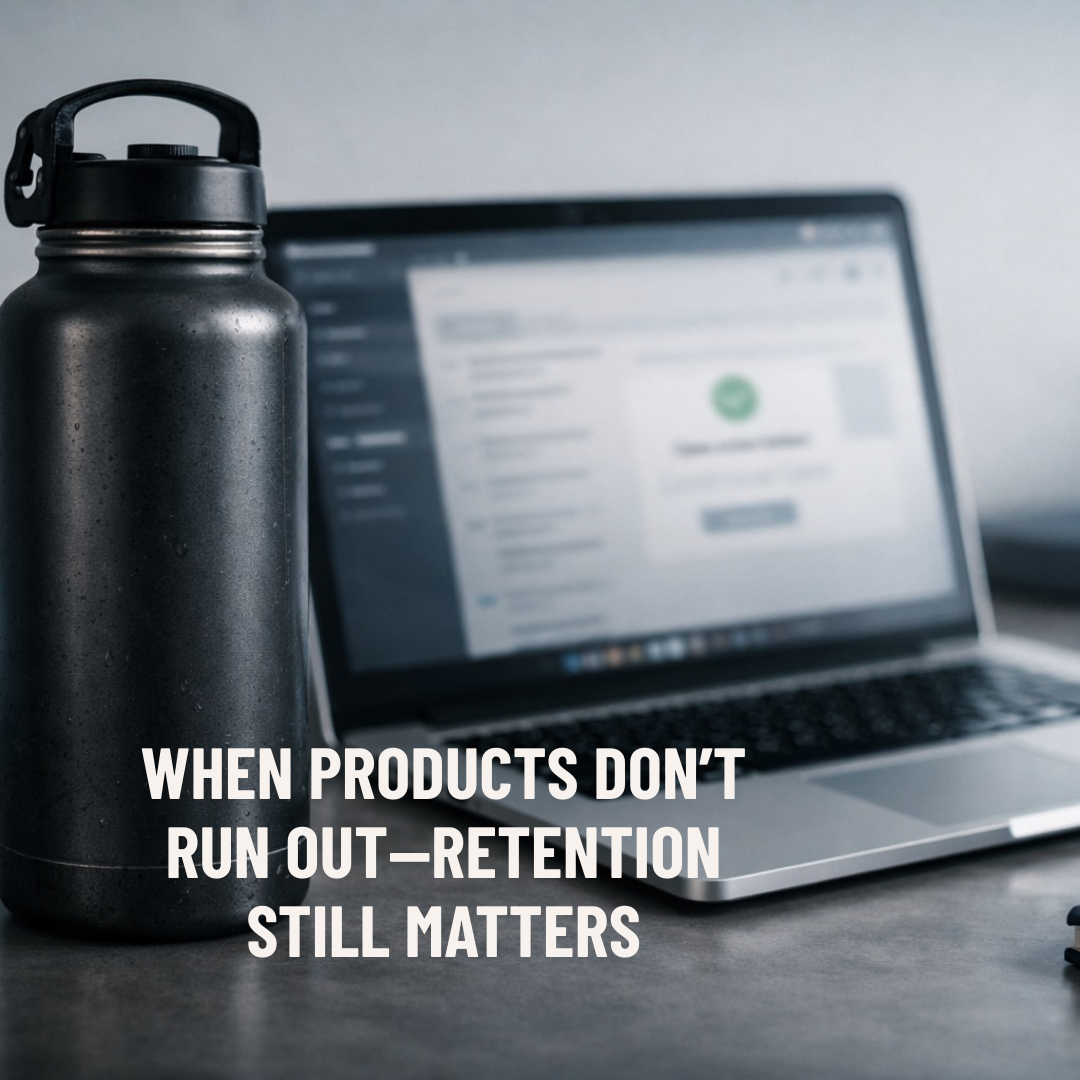
Years ago, I bought a 40oz metal water bottle.
No plastic, keeps the water cold, and, well, holds a lot of water.
It’s sitting next to me as I write this, years later, delivering an ice-cold sip of H20 every few minutes.
I doubt I’ll ever have to replace this thing.
Which begs the question:
How would this brand keep me as a repeat customer if I won’t need to “replace” or “reorder” my water bottle?
This is a problem all nonconsumable product brands face. It’s built into the business model.
See, customer retention is straightforward for consumable products. Get the customer to understand the long-term benefits of your product… so they keep refilling again and again.
Nonconsumables? Ideally, they’re “buy once, cry once.”
Planned obsolescence isn’t the way to go. That’s the “broken window” economic fallacy.
Breaking something to sell more creates value…
When, really, you’re robbing customers of value to generate artificial demand.
So how do you sell a customer more of the same product if they don’t need to replace it?
Stop right there.
That thought process is what’s limiting you from getting customers to come back and buy more…
| Table of Contents |
| The Common Misconception With Nonconsumables and Retention Repeat Purchases Aren’t About Consumption 5 Things to Try Retention: A Design Problem, NOT a Product Problem What to Do Next |
The Common Misconception With Nonconsumables and Retention
Most brands tie repeat purchases directly to consumption.
No consumption → no repeat purchases.
So retention efforts, from certain post-purchase communications to upsells, feel forced after the first product arrives.
Eventually, customers drift away due to inertia.
The truth is, the factor driving repeat purchases is not the “running out” aspect. Even for consumables, that’s the superficial cause.
Let’s dig deeper…
Repeat Purchases Aren’t About Consumption
The real cause for buying again is filling a specific need.
For consumables, that need is almost always “keeping the routine going.” Not pure “running out.” Subtle difference.
But for nonconsumables, there are several needs:
- Different use cases: Additional units for different purposes
- Redundancies: A backup in case the primary purchase is out of commission
- Gifting: Spreading the love to family and friends
- Expansion: Getting products that complement what they have or make it work better
- Novelty: Getting new, different versions or products
Once you see repeat purchases this way, retention stops feeling abstract or impossible.
It becomes a matter of uncovering reasons to return — even when the original product still works perfectly.
That’s where the strategies below come in.
5 Things to Try
1. Leverage Gifting As a Built-In Second Purchase
Consumables can be decent gifts, but they go away with use…
Whereas nonconsumables are, by their nature, long-lasting and reusable.
Thus, many nonconsumables make for excellent gifts, even if they vary in how giftable they are.
If customers like your product, gifting is the most natural second purchase. The mistake brands make is waiting for customers to figure this out on their own.
Instead, actively push the gifting angle. Here are some places you could do so:
- Post-Purchase Flow emails
- As the holidays approach
- Near birthdays (justify buying a second one for themselves as a self-gift)
- For other people’s birthdays
- As a general “love/appreciation” gift for a close friend or significant other
I worked with a sleep headphones brand (the kind that sits in a fabric headband) that had a lot of customer testimonials about gifting.
Some said they had bought multiple pairs for others (who all loved it), while others were recipients and loved it.
We pushed that gifting angle in a few places and boosted sales.
2. Sell The “Backup Pair”
I recently forgot my main pair of Bluetooth headphones at home when I drove to one of my running clubs, so I had to use my old AirPod Pro (the left one, since the right one broke).
That redundancy saved me a music-less run.
This logic applies to your customers, too. People buy backups to avoid inconvenience:
- One at home, one at work (and maybe a third for travel)
- One in use, one just in case
- One now, one for later
Returning to my sleep headphones client…
We wrote a post-purchase email on charging habits to keep their headphones charged and ready every night…
Then sold the backup pair as “insurance” in case they forgot to charge those headphones.
That was their best-performing post-purchase email.
3. Expand the Relationship With Cross-Sells
The previous two sections cover ways to sell more of the same product. But why not sell them a different product?
Accessories, complementary items, upgrades, or adjacent products can all extend the relationship.
The key is relevance:
- Does this make the original product more useful?
- Does it unlock a new use case?
- Does it improve the overall experience?
Cross-sells shift retention from “buy again” to “build around what you already own.”
For the sleep headphones brand… they sold:
- Nighttime headphones: The flagship product, designed to help sleep.
- Daytime headphones: More durable and sweat-wicking, and keeps your head warm. Good for walking, exercise, and so on.
- Spare batteries: For those who don’t want to buy a whole second pair.
- Spare headbands: For those who need to replace just the headband.
Our main cross-sell was daytime headphones → nighttime headphones, and vice versa.
4. Find Affiliate Offers That Pair Well
Affiliate offers let you add new offers to your business quickly, with little effort.
They give you:
- A reason to email again
- Added value for customers
- Incremental revenue without inventory or logistics
You get a commission for each sale.
(Bonus points if the affiliate offer pays recurring commissions, such as a SaaS program. Solves your nonconsumable problem.)
I did with my sleep headphones client, too. I found an app called BetterSleep that pairs perfectly.
BetterSleep has sleep soundscapes, bedtime stories, the ability to custom-make a sleep sound playlist, and so on. It can also track your sleep/snoring and tell you your optimal sleep hours.
I leapt on that immediately, and we upsold some customers in the Post-Purchase flow.
Another example: A lifting gear brand may get an affiliate membership with a fitness tracker app. It’s a natural next step — someone taking the supplement needs to track their workout and/or diet.
Or, it might get an affiliate membership with a supplement brand. That unlocks a “consumable” offer without the lifting gear brand needing to get into supplements themselves.
5. Launch Limited-Edition or Seasonal Variations
People like novelty. It triggers something in the brain.
It also strengthens the sense of urgency when the new thing is limited in time or quantity.
Launching limited editions, seasonal variations, or small visual changes (colors, finishes, scents, designs) give customers a reason to come back now, not “someday.”
No need to permanently expand your product line, either.
For instance, I worked with a belt brand that launched limited-edition belts a couple of times. They came with unique materials and cool colors/designs to draw attention and create a “collector’s item” feel.
Launching new permanent product lines uses the same concept discussed here.
The only difference is that new products tend to be more different and involve more risk (such as tying up capital in unused inventory if the product flops).
Retention: A Design Problem, NOT a Product Problem
Crafting a high-quality product can seem to work against you by rendering the “refill/replace” logic moot via longevity and durability.
At the end of the day, however, products fill needs.
The first purchase solves the core problem the product exists for.
But ownership creates new needs, such as backup versions, extra units for different use cases, complementary products (yours or an affiliate’s), and gifting.
Retention comes from identifying those downstream needs and intentionally designing the customer journey to meet them.
Identify those needs and structure your customer journey around addressing all of them.
Do that, and high product quality stops working against you…
And starts working in your favor.
What To Do Next
- Share this article with someone who might find it helpful (or entertaining).
- Subscribe to my Substack to get these in your inbox every Friday.
- Get my free eBook using the form below to learn the 5 things stopping you from turning “one-and-done” customers into repeat buyers.
- Grab my 21 best email templates/frameworks.
- Reach out to me if you have a sizable email list and make less than 20% of your revenue through email.