I’ve worked with a lot of brands across niches and business models — different products, audiences, traffic sources…
Heck, even a couple of nonprofits.
One recurring pattern I noticed is that I kept having to help rethink and revamp their offer structures.
Customers were being asked to make too many decisions, choose from an excessive number of options, or figure out how much to buy and what comes next.
And so customers fell off…
Not out of hating the brand, but because it was too hard for them to pull the trigger on their order.
Yet by fixing the offers, we were able to increase front-end sales and, in many cases, boost AOV…
Leading to better cash flows and quicker payback periods.
Think of the offer structure like a multiplier. Holding the customer count equal, a well-structured offer can get more sales.
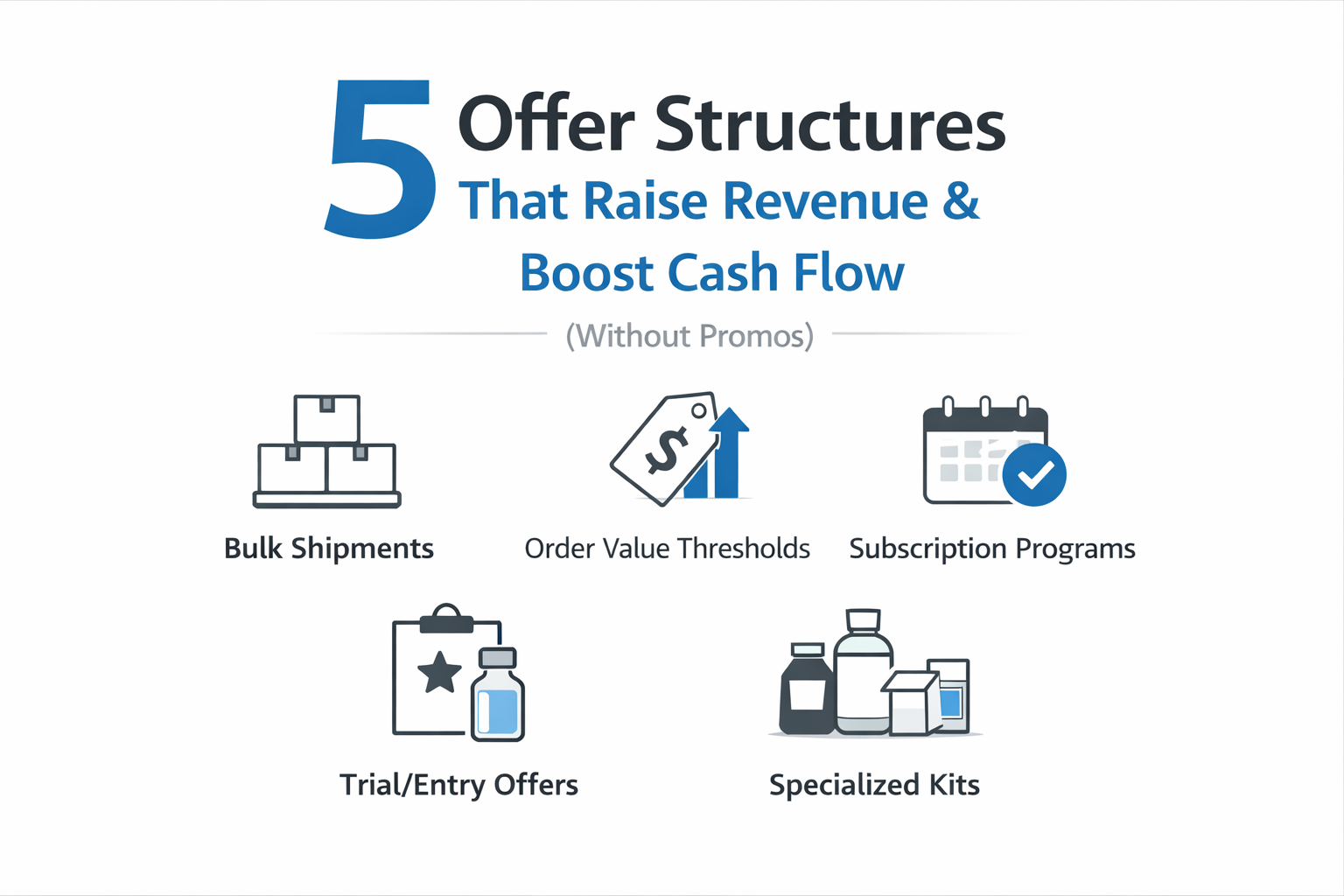
So today, we’ll break down five ways you can structure your offers on your site/store to increase sales and strengthen retention.
Implementing just one can make a noticeable difference.
Let’s get into it…
| Table of Contents |
| 1. Bulk Shipments 2. Order Value Thresholds 3. Subscription Programs 4. Trial/Entry Offers 5. Specialized Kits Offer Structure is Strategy What to Do Next |
1. Bulk Shipments
Bulk shipments increase revenue and cash flow immediately by pulling demand forward and boosting AOV per order…
Without changing the product.
In exchange, you offer a small bulk discount (otherwise, there’s no point, since customers could buy several units of the regular quantity).
Bulk shipments work well for consumables. Once a product becomes part of someone’s routine, buying in larger quantities feels logical rather than risky.
Plus, you give customers more options — notably, different types of repeat customers:
- Customers who use more of the product and want extra
- Customers who wish to spend windfalls on your products
- Customers who love the product and want longer regular access without a subscription
Together: Repeat customers (who are already more likely to buy) can buy much more at once, surging cash flows.
Green Valley Naturals offers a simple example of a bulk supplement shipment offer:

Order in bulk to knock a few bucks off each bottle and get free shipping. Excellent for people who already benefit from it or want to increase their dose.
Another example…
Clean Skin Club offers multiple quantity options:

The brand labels two with “Most Popular” and “Best Deal”. These reduce decision fatigue, helping customers pick an option.
I’d suggest making price comparison easier so customers don’t have to click each pack to see pricing.
Instead, they’d see, at a glance, that the 10-pack is indeed the best deal.
2. Order Value Thresholds
Order value thresholds unlock perks when a customer’s order amount reaches a specific amount. This raises AOV without discounts.
Such a structure encourages customers to add a bit more to their cart to unlock that benefit. In some cases, the customer doesn’t “barely reach the threshold”…
But, based on their desires and your pricing, goes a healthy amount over it.
Common perks for hitting thresholds include:
- Free shipping
- A free gift
- Extra loyalty points/points multipliers
Supplement brand re:vitalize has a simple threshold offer:

I’ve also worked with brands that had multiple thresholds. One, for example, did:
- Tier 1: Free shipping at $99+
- Tier 2: Tier 1 + free gift at $129+ (a piece of merch that wasn’t available for purchase)
- Tier 3: Tier 2 + another free gift at $159+ (a free one of their products)
So customers could secure free shipping and TWO free gifts with large orders.
3. Subscription Programs
Subscription programs trade one-off purchases for predictable, recurring revenue by turning repeat one-off customers into recurring billing/delivery customers.
This is less about immediate cash flow and more about ongoing cash flow.
Ordering becomes the default. They must opt out of it (each one-off order is an “opt-in”). This removes decision-making and friction from a customer POV.
You can’t set a subscription and forget it, though, if you want to reduce churn, increase subscription value, and maximize revenue.
Each renewal is a decision point.
A chance to re-sell customers on the benefits and get them to expand their commitment to the brand via more subscriptions (often through email).
But this isn’t too tough since your customer trusts you enough to get on a subscription.
You shift from “get the next sale” to “retain them over time.”
And, anyway, most brands toss a small discount and/or perks into subscription programs to “grease the skids” and get the customer to commit.
Heart & Soil demonstrates this well. They don’t treat their subscription program as an afterthought…
Instead, you can toggle “Shop Subscriptions,” centering the subscription as an equally valid offer.

Cuts out the intermediary step of guiding one-off customers to a subscription.
(Psst: I broke down a Heart & Soil email in excruciating detail. Check it out here.)
4. Trial/Entry Offers
Getting a new customer in the door is one of the hardest parts of marketing. A trial/entry offer fixes that by lowering barriers and removing friction without cheapening the product.
By reducing perceived risk through smaller sizes, starter pricing, or low-commitment options, these offers make that first “Yes” easier.
When done well, these attract higher-intent buyers than steep discounts. That’s because they appeal to customers who want to test fit and results before committing further.
That’s a different mindset than “I need the cheapest deal possible.”
After all, your front-end’s goal is to get a customer as efficiently as possible. NOT to profit. Profit happens on the back end. Front-end profit is a secondary goal for most brands.
Brickell, a men’s skincare company, offers a free kit to first-time customers.

Brickell lays out what’s in it:

The goal is to get a “win” with the free kit so customers see results and then want to buy more (ideally, a subscription).
But Brickell doesn’t miss upsell opportunities:

Brickell collects revenue on a free offer — an otherwise loss leader — by providing other offers:
- A spend threshold (see Section 2 earlier in this article)
- Recommended product pairings
- Free months of Platinum VIP Membership
Brickell’s a big brand. I assume this is working well for them.
5. Specialized Kits
Specialized/branded kits/bundles make it easier for customers to buy and succeed. These kits are built around goals or identities that resonate with the customer.
This reduces decision fatigue, shopping time, and uncertainty by not forcing customers to piece together individual products. Thus, sales increase.
It also boosts AOV without feeling promotional.
You’re not shoving more products on them for the sake of sales, but offering a curated selection that fits an overarching theme. The bundle is incomplete if any item is missing.
Just as importantly, kits improve product adoption.
By defining how customers should use products together, you set clear expectations for what success looks like.
When customers know how and why to use what they bought, it becomes easier for them to see value…
Then return and buy again.
Take a look at Good Ranchers, a meat subscription box brand:


Want to cook at home? Grab the Home Cook Box.
Need to prep for gameday? Get the Tailgate Box.
Swapping to seafood? The Wild-Caught Seafood Box is there.
(Psst: I broke down a Good Ranchers email in great detail. Check it out here.)
But… Good Ranchers only sells themed boxes. Let me show you a brand that offers single items AND themed bundles.
Breathe Naturals Deodorant, an all-natural/organic deodorant brand, has a few bundles curated for different customers.

Hard to see, but there are 4 options on the homepage:
- The Dude Pit Pack: Men’s deodorant bundle with 3 scents for men
- The Chick Pit Pack: Women’s deodorant bundle with 3 scents for women
- Santa’s Pit Pack: 3 festive scents (that make good gifts… if the recipient is ok being told they stink!)
- The Family Pit Pack: A larger bundle with more scents for families. Also works as a “give me one of everything.”
(Psst: I broke down a Breathe Naturals email. Two of them, actually. Part 1 is here… Part 2 is here.)
Offer Structure is Strategy
How you package products impacts how customers buy — who, how often, and how much.
You don’t need all these structures at once. In fact, it will take a good amount of work to implement all of these in a way that doesn’t clutter your online presence or confuse customers.
But when your offers are intentional and crafted with the customer in mind, revenues and cash flows improve…
And growth stops feeling Sisyphean.
What To Do Next
- Share this article with someone who might find it helpful (or entertaining).
- Get my free eBook using the form below to learn the 5 things stopping you from turning “one-and-done” customers into repeat buyers.
- Grab my 21 best email templates/frameworks.
- Reach out to me if you have a sizable email list and make less than 20% of your revenue through email.