Most times, when I log into a new client account, I see a particular mess:
A flurry of tags and segments.
Sometimes, I also see campaigns or flows sending to tiny sections of the list based on micro-behaviors no one’s using.
So much effort and stress over segments and slicing that won’t ultimately move the needle.
Think of the Pareto Principle, aka the 80/20 rule.
20% of the work drives 80% of the results.
In this case, a handful of segments drive 80% of the revenue (and maybe more).
Those are the ones you:
- Mail and generate revenue from
- Monitor for deliverability
- Explore winback opportunities with
I have indeed created special segments for specific purposes with certain clients.
But these are exceptions and often for temporary use.
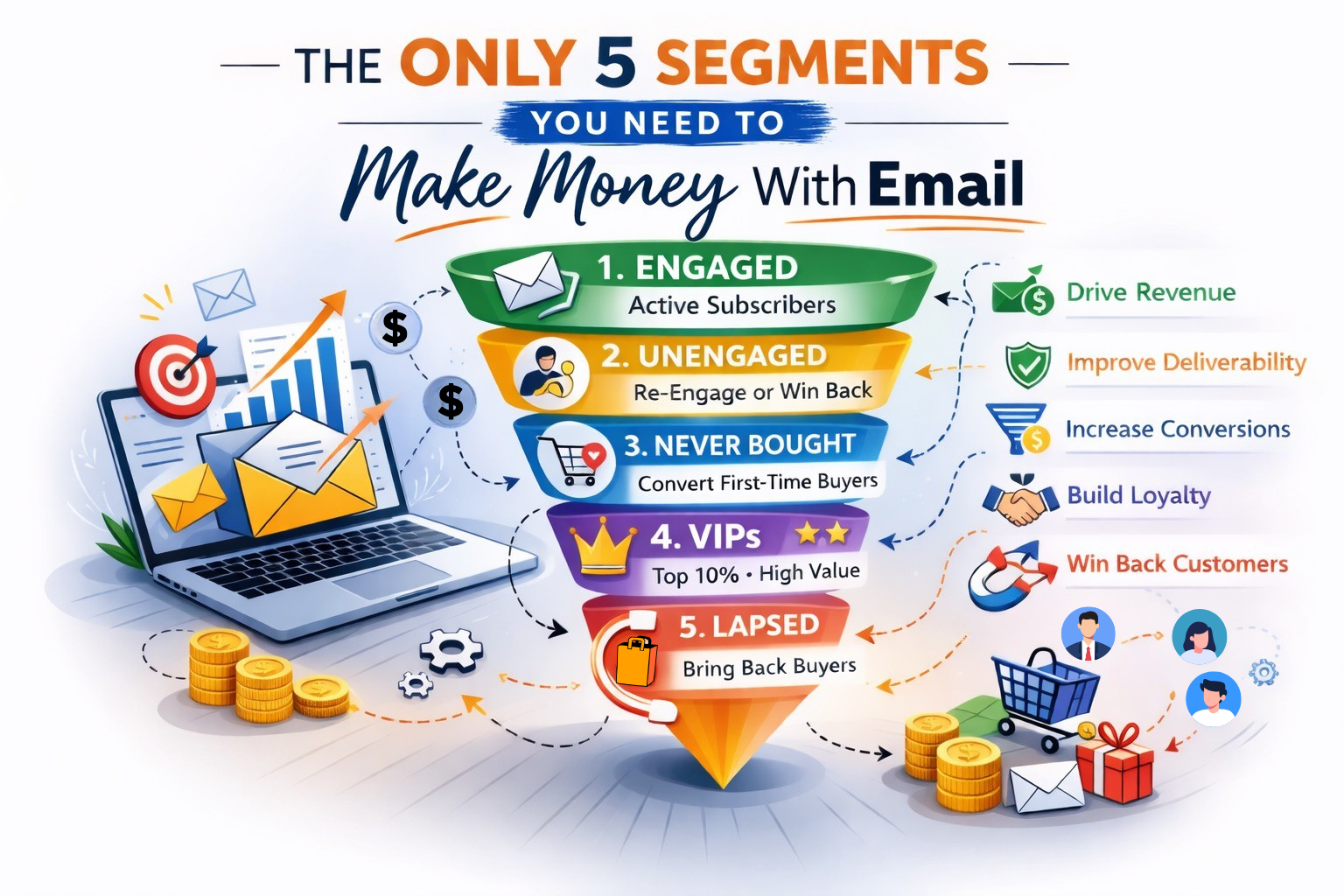
Here are the only five I use almost all of the time, across niches, business models, and list sizes.
| Table of Contents |
| 1. X-Day Engaged 2. Unengaged 3. Never Bought 4. VIPs 5. Lapsed Note: Overlap is Possible Keep Your Segmentation Simple (KYSS) What to Do Next |
1. X-Day Engaged
This is your active audience.
You’ll send your regular emails here. You’ll promote harder (sales, launches, etc.) to this audience, too.
Anyone who opens, clicks, or buys from you goes in here. Some brands also count browsing their site and/or viewing their products as “engagement.”
As for the “X”, aka how long to make the “engagement window”…
Up to you.
Common timeframes include 30, 60, 90, 120, or 180 days. Pick what makes sense.
You can then expand or contract that window based on engagement (usually trends in open rates).
I send almost ALL campaign emails to this segment.
Some brands pursue a more advanced strategy of using multiple engaged segments. Some get more emails (and different types) than others.
But this isn’t necessary for most. And, these days, AI personalization tools can help with the “tailoring messaging to different types of people” aspect.
2. Unengaged
This is everyone who sits outside your chosen Engaged window.
They aren’t useless. They’re cold, and you could reactivate some.
Ignoring them completely is a mistake, but so is blasting them with every regular send as if they’re in the Engaged segment.
Unengaged subscribers require one of three actions:
- Re-engage them with a focused campaign
- Reduce frequency
- Sunset or suppress them after longer periods of engagement
When I run promos, I often include them in the morning promo announcement and morning last-call emails.
All others, including those two days’ evening sends, go only to the Engaged segment (although I may widen the engagement window).
3. Never Bought
The “Never Bought” segment comprises leads who never moved forward with their first order.
Generally, you move people into this segment after they complete your Welcome Sequence without buying.
No need to run constant discounts… but I have seen limited-time discount promos work for the “Never Bought” types.
For example, one brand sent me an email along the lines of “hey, looks like you never ordered with us before. Here’s 15% off until tomorrow.”
This was months after I opted in.
I didn’t buy, but it got my attention.
(Other types of incentives could work, too. Depends on niche and business model.)
Aside from that, you can continue to educate them similarly to the Engaged Segment.
All that said…
This segment is more for visibility. It’s another way to see the effectiveness of your Welcome Sequence and to understand how many “new” people you have relative to returning customers or your whole customer base.
4. VIPs
VIPs (sometimes called “whales”) are your top 10% of customers by revenue/lifetime value (some brands expand to top 15%).
They generate disproportionate profit in most cases, yet most brands don’t treat them as special. Makes it harder to keep people around.
Segmenting your VIPs lets you:
- Offer early access
- Give exclusive perks/offers
- Increase order frequency
- Introduce higher-ticket offers
And, of course, create a VIP flow that welcomes them to their exclusive status.
Now, if these people make you the most money… you want more of the same types of people.
Study this segment. Look for what these people have in common. Use that to inform your acquisition efforts.
5. Lapsed
These are previous buyers who haven’t purchased in a defined time window.
Some are easier to convert than new products — usually those who canceled for budgetary or other non-emotional reasons.
Others may be a bit tougher.
Either way, don’t treat them like brand new subs. They have a relationship with your brand.
Instead:
- Remind them what they bought
- Show them what’s new
- Introduce complementary products
- Offer replenishment timing
- Reintroduce value
Most brands use a Winback Flow to get these customers back automatically, the moment they become “Lapsed.”
Not every customer buys off the Winback Flow… leaving them in Lapsed status.
THAT’S when you can run the occasional lapsed customer winback campaign.
Note: Overlap is Possible
Overlap can happen between segments. That’s not a cause for concern.
For instance, any unconverted leads post-Welcome Flow will end up in Never Bought and your Engaged segment.
That’s fine. It’s how it’s supposed to work.
Regular “Engaged” content and “Never Bought” content should both appeal to them.
Keep Your Segmentation Simple (KYSS)
There is no need to subdivide your audience into oblivion.
At some point, you’ll be trying to send 10 emails a day to hyper-segmented slices of your audience.
All you need are:
- Engaged (to drive revenue)
- Unengaged (to protect deliverability)
- Never Bought (to convert)
- VIPs (To strengthen loyalty and give good market research)
- Lapsed (To bring back)
If you consistently market with those five segments in mind, you’ll cover the majority of revenue opportunities without drowning in complexity.
That said…
Some AI tools can help you hyper-segment without manually building and managing each — at least when it comes to email flows.
RightMessage, for example, lets you tag people based on survey questions, then auto-serve them copy tailored to their specific persona.
In other words, the copy adapts to the type of person reading it.
Landing pages, email flows, lead magnets… you name it, RightMessage helps with it.
The result is “one-to-many” marketing that feels “one-to-one”.
Learn more about RightMessage here.
What To Do Next
- Share this article with someone who might find it helpful (or entertaining).
- Subscribe to my Substack to get these in your inbox every Friday.
- Get my free eBook using the form below to learn the 5 things stopping you from turning “one-and-done” customers into repeat buyers.
- Grab my 21 best email templates/frameworks.
- Reach out to me if you have a sizable email list and make less than 20% of your revenue through email.